
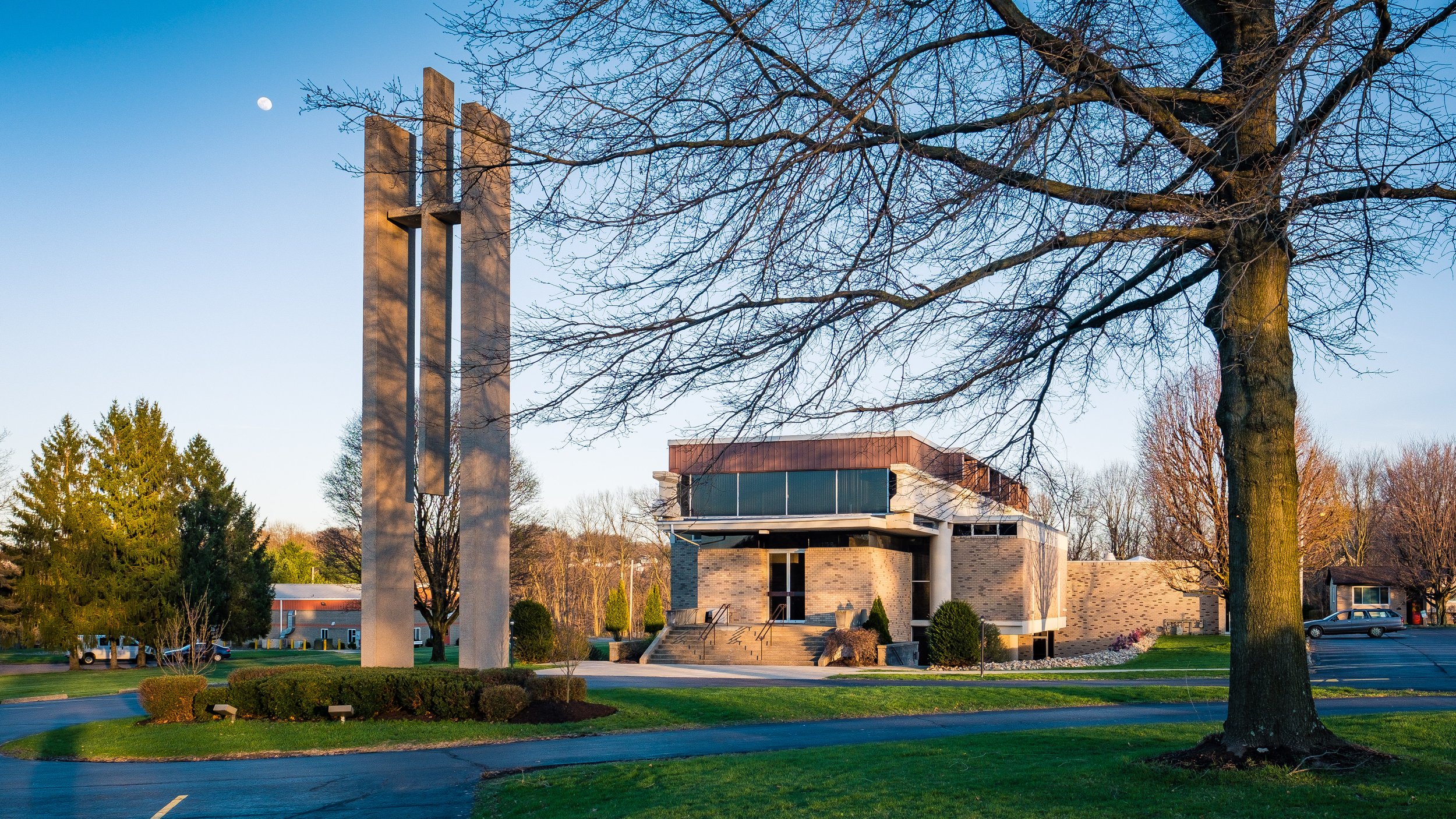
Bulletin: Sunday, November 16, 2025 + This Week at Zion
Download/view the latest bulletin. It’s filled with our hymns, the order of service, all the readings from scripture, prayer requests for family & friends, service participants, communion statement, about our worship, the schedule of events for this coming weeks, along with announcements, news updates, happenings, and more!
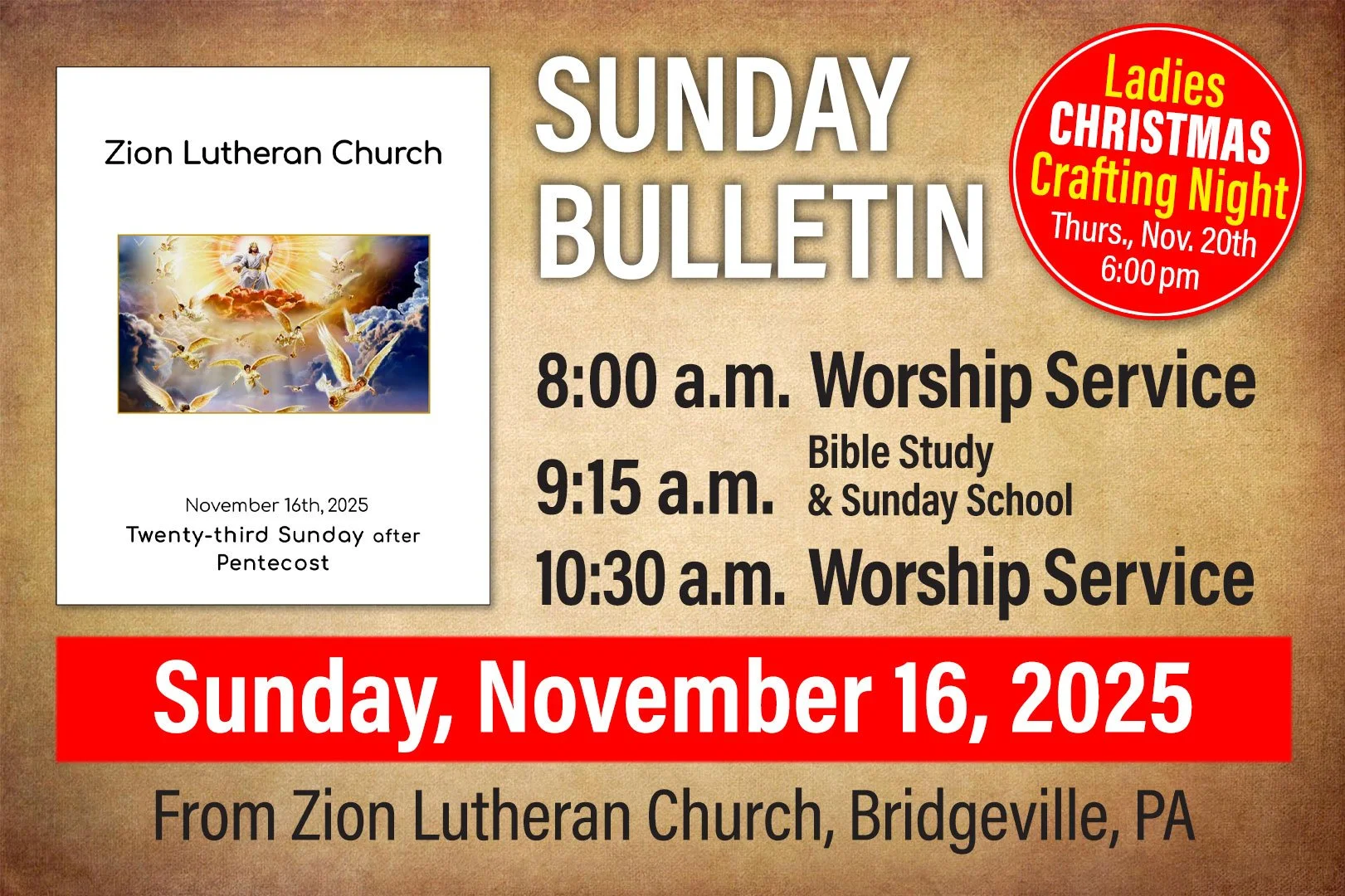
View the bulletin for Sunday, November 16, 2025
Archive of AUDIO “Readings & Sermons”
Archive of VIDEO “Complete Service”
Archive of Bulletins
THIS WEEK AT ZION
Saturday, November 15
No Events Scheduled
Sunday, November 16
8:00 a.m. — Worship Service with Communion
9:15 a.m. — Adult/Teen Bible Study & Sunday School
10:30 a.m. — Worship Service with Communion
6:00 p.m. – Youth Group Putt-Putt Golf & Spiritual Conversations Bible Study
(The 8:00 a.m. service streamed on our YouTube channel)
Monday, November 17
6:00 p.m. - 1st Year Confirmation Class
7:00 p.m. - 2nd Year Confirmation Class
Tuesday, November 18
6:15 p.m. - Bell Choir Practice
7:15 p.m. - Adult Choir Practice
Wednesday, November 19
2:00 p.m. - Midweek Worship Service with Communion
2:30 p.m. - 30-min. Bible Study, Psalm 118
(Service streamed on our YouTube channel)
Thursday, November 20
6:30 p.m. - Ladies Christmas Crafting Night & LWML Quarterly Meeting (additional details)
Friday, November 21
No Events Scheduled
Saturday, November 22
4:30 - 7:30 p.m. - Michael Migyanko Baptism & Reception
Sunday, November 23
8:00 a.m. — Worship Service with Communion
9:15 a.m. — Adult/Teen Bible Study & Sunday School
10:30 a.m. — Worship Service with Communion
(The 8:00 a.m. service streamed on our YouTube channel)

CLICK THE UPCOMING EVENTS GRAPHIC to go directly to our UPCOMING EVENTS page
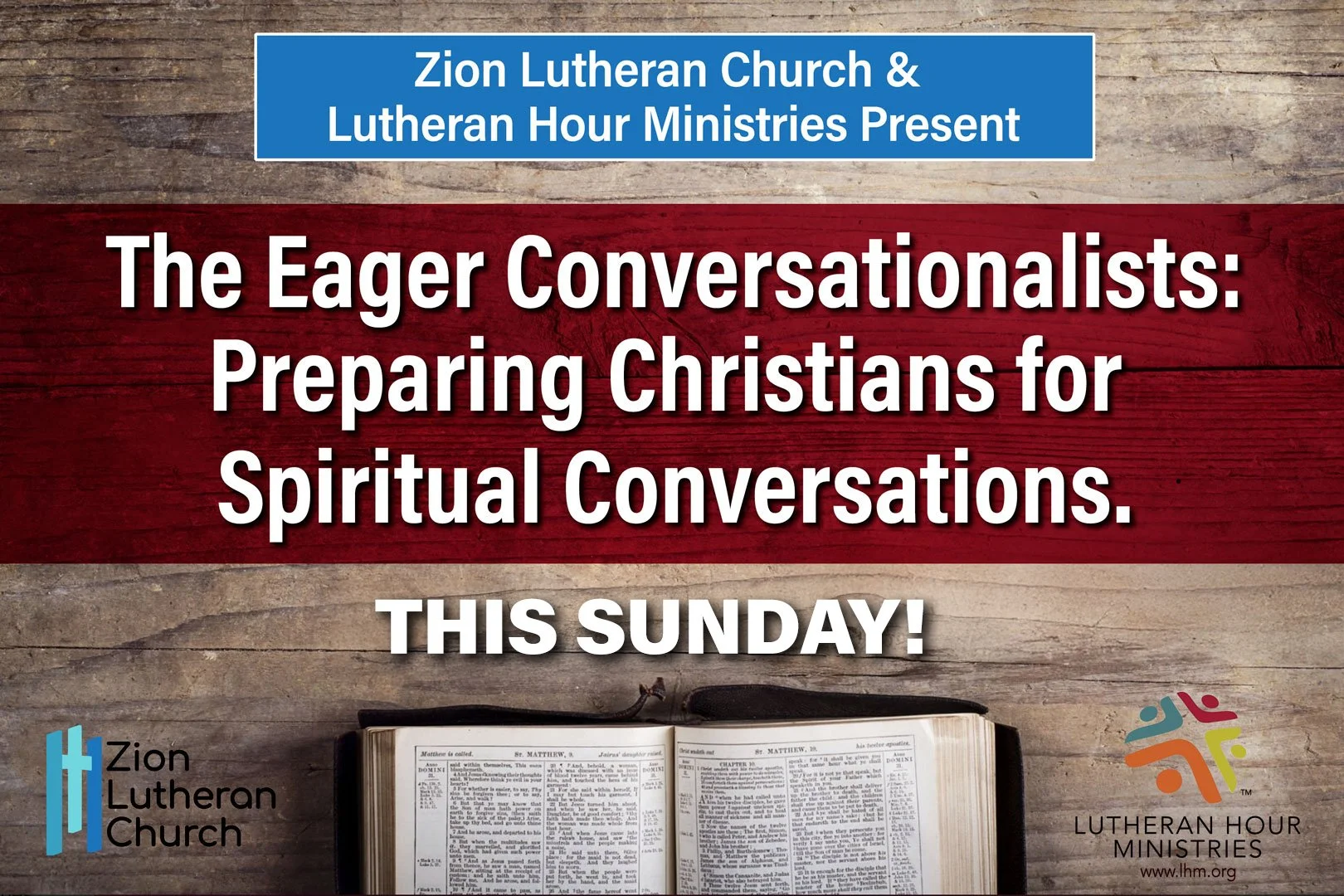
Sunday’s Bible Study: Spiritual Conversation Workshop
In this four-week series, starting Sunday, November 16, 2025 we will examine
The Eager Conversationalist/Spiritual Conversation Curve Workshops
Drawing on Barna Group data contained in the 2018 monograph Spiritual Conversations in the Digital Age, Lutheran Hour Ministries is offering two workshops: the first, Eager Conversationalists, examines spiritual conversations. It offers insights to help us become more intentional-more eager-to engage in spiritual conversations with others. The second, The Spiritual Conversation Curve, offers help in getting past conversational hurdles. This is possible when we focus on someone’s “spiritual posture,” so as not to impose a conversation that’s forced or ill-timed.
A video and downloadable PDF’s will be available for home use — coming soon.
In this four-week series, starting Sunday, November 16, 2025 we will examine
The Eager Conversationalist/Spiritual Conversation Curve Workshops
Drawing on Barna Group data contained in the 2018 monograph Spiritual Conversations in the Digital Age, Lutheran Hour Ministries is offering two workshops: the first, Eager Conversationalists, examines spiritual conversations. It offers insights to help us become more intentional-more eager-to engage in spiritual conversations with others. The second, The Spiritual Conversation Curve, offers help in getting past conversational hurdles. This is possible when we focus on someone’s “spiritual posture,” so as not to impose a conversation that’s forced or ill-timed.
A video and downloadable PDF’s will be available for home use — coming soon.
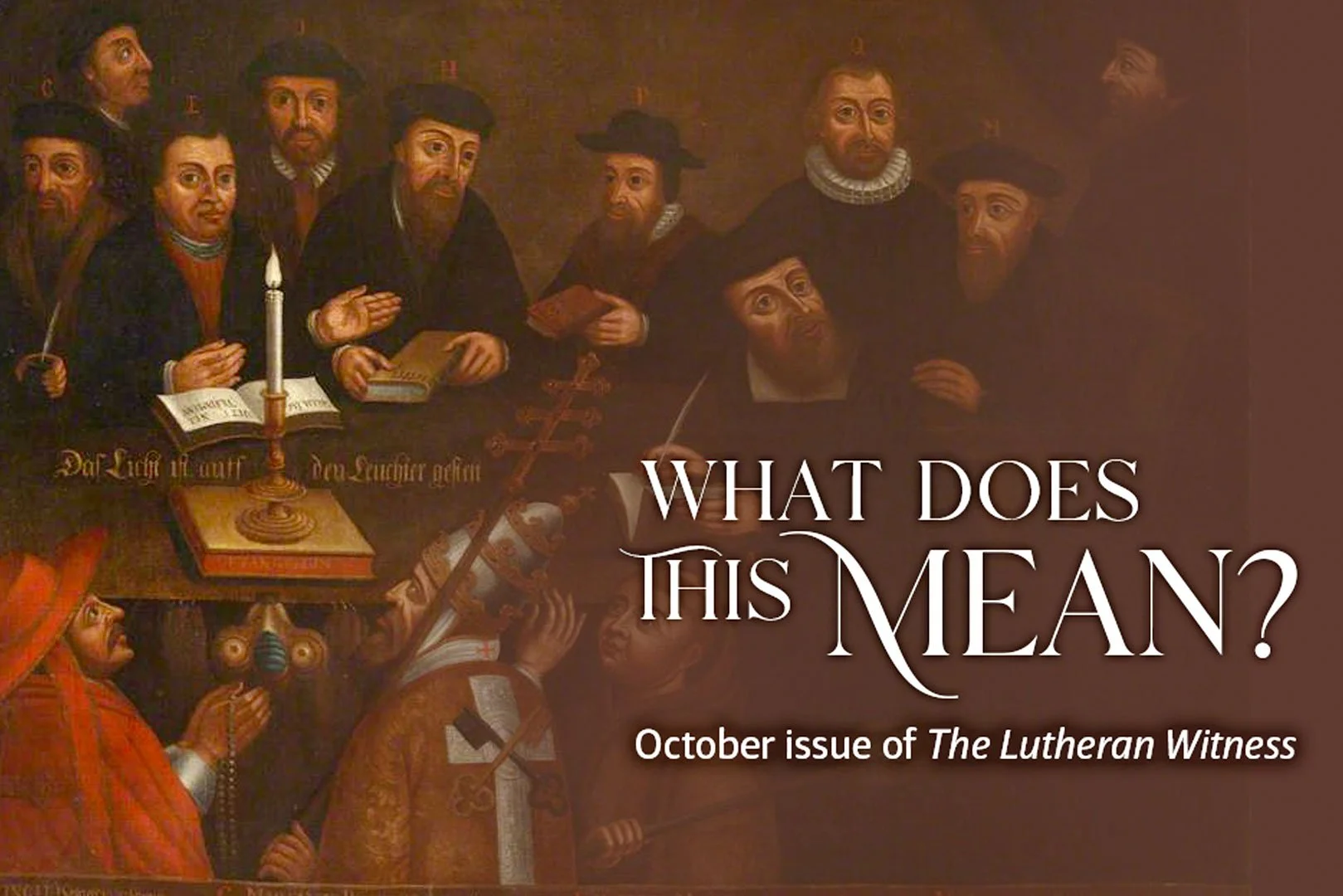
Inspiration: What Does This Mean?
The October 2025 issue of The Lutheran Witness provided definitions and explanations of nine different words we use often as Lutherans — and unpacked how other denominations use those terms differently.
Definition:
Inspiration is God’s divine action whereby the Holy Spirit breathed into the biblical authors not only the ideas but the very words of Holy Scripture, making every part of the Bible the infallible, inerrant Word of God.
Lutherans Confess:
“All Scripture is breathed out by God,” wrote Paul in 2 Timothy 3:16. Lutherans teach “verbal inspiration,” meaning that every word of Holy Scripture was inspired by the Holy Spirit. We believe that this inspiration extends to all of Scripture.
Through His Word, God reveals Christ’s atoning work on the cross for the salvation of humanity. However, Lutherans do not believe that this core message is the only thing in Scripture that is inspired. Lutherans teach that all of the details in Scripture, such as doctrine, chronology, historical events, geography, etc., were all inspired by the Holy Spirit.
Click the link below to read the complete story …
The October 2025 issue of The Lutheran Witness provided definitions and explanations of nine different words we use often as Lutherans — and unpacked how other denominations use those terms differently.
Definition:
Inspiration is God’s divine action whereby the Holy Spirit breathed into the biblical authors not only the ideas but the very words of Holy Scripture, making every part of the Bible the infallible, inerrant Word of God.
Lutherans Confess:
“All Scripture is breathed out by God,” wrote Paul in 2 Timothy 3:16. Lutherans teach “verbal inspiration,” meaning that every word of Holy Scripture was inspired by the Holy Spirit. We believe that this inspiration extends to all of Scripture.
Through His Word, God reveals Christ’s atoning work on the cross for the salvation of humanity. However, Lutherans do not believe that this core message is the only thing in Scripture that is inspired. Lutherans teach that all of the details in Scripture, such as doctrine, chronology, historical events, geography, etc., were all inspired by the Holy Spirit.
God is the true Author of every word of Scripture — which makes it qualitatively different from all other human writings. Since God cannot err, His inspired Word contains no errors in any part (LC IV 57). As Psalm 12:6 puts it, “The words of the Lord are pure words, like silver refined in a furnace on the ground, purified seven times.” Because Scripture is God’s inerrant Word, Lutherans hold that the Bible is “the judge, rule, and norm. According to them — as the only touchstone — all teachings shall and must be discerned and judged to see whether they are good or evil, right or wrong” (FC Ep, Rule and Norm, 7). All right doctrine and theology are judged according to the standard of Scripture.
Unpacking Other Definitions:
Subordinated to church tradition: While the Roman Catholic Church acknowledges that Scripture is “inspired,” the language of Vatican II teachings leaves room for potential errors in Scripture on non-salvific matters. Catholics also subordinate the authority of Scripture to church tradition and papal authority and maintain that Scripture’s meaning and authority are determined by the Catholic Church’s magisterium. In other words, in Catholic theology, “inspiration” does not guarantee Scripture’s independent authority — the Scriptures need the church to authoritatively interpret them. Similarly, Orthodox theology sees Scripture and tradition as two aspects of a single divine revelation, with the church’s liturgical and patristic tradition serving as the interpretive key to Scripture’s meaning.
Subject inspiration: Mainline Protestant denominations often adopt something called “subject inspiration,” the view that God inspired the biblical writers’ thoughts or persons rather than their words. This position leaves room for significant human error in Scripture while maintaining that it contains God’s revelation. Some describe the Bible as “containing” God’s Word rather than “being” God’s Word, making human reason and experience judges over scriptural authority. The historical-critical method often assumes that errors exist, requiring scholarly reconstruction of the “original” message — which often dismisses things like prophecy and miracles.
Propositional truths: Many evangelical denominations strongly affirm biblical inerrancy, often with language similar to the Lutheran Confessions. However, their understanding frequently lacks the Christocentric focus that characterizes Lutheran interpretation. Evangelicalism sometimes treats Scripture as a collection of propositional truths rather than as the living Word that creates faith through Law and Gospel, thus divorcing biblical authority from its proper purpose of proclaiming Christ.
Ongoing inspiration: While generally affirming biblical inspiration, many Pentecostal and charismatic movements emphasize ongoing revelation through prophecy, tongues and direct spiritual experiences. This can diminish Scripture’s unique authority by placing contemporary “revelations” on equal (or even superior) footing with biblical texts. This can subordinate the biblical texts to subjective spiritual experiences.
From Scripture:
“All Scripture is breathed out by God and profitable for teaching, for reproof, for correction, and for training in righteousness” (2 Tim. 3:16).
From Our Confessions:
“We know that God does not lie [Titus 1:2]. I and my neighbor and, in short, all people, may err and deceive. But God’s Word cannot err” (LC IV 57).
“See how they love one another”
Roseto, Pennsylvania. Its reputation: the healthiest town in America. At the center of that claim is an amazing story.
Many of the inhabitants of the town trace their ancestry to the village of Roseto Valfortore, located 100 miles southeast of Rome. The medieval village centers on a town square and a church named Our Lady of Mt. Carmel. Narrow stone steps run up the hillside flanked by rows of stone houses with red tile roofs. The major industry there: stone quarries, located in the surrounding hills. Villagers would walk 4 to 5 miles each way to work, down the mountain and back, leaving early and returning late.
In 1882, a group of 11 Rosetans set sail for New York City. They spent some time in what is known as “Little Italy,” and then travelled 90 miles west to a location near Bangor, Pennsylvania, in order to work in a slate quarry there.
Click below to read the complete story ….
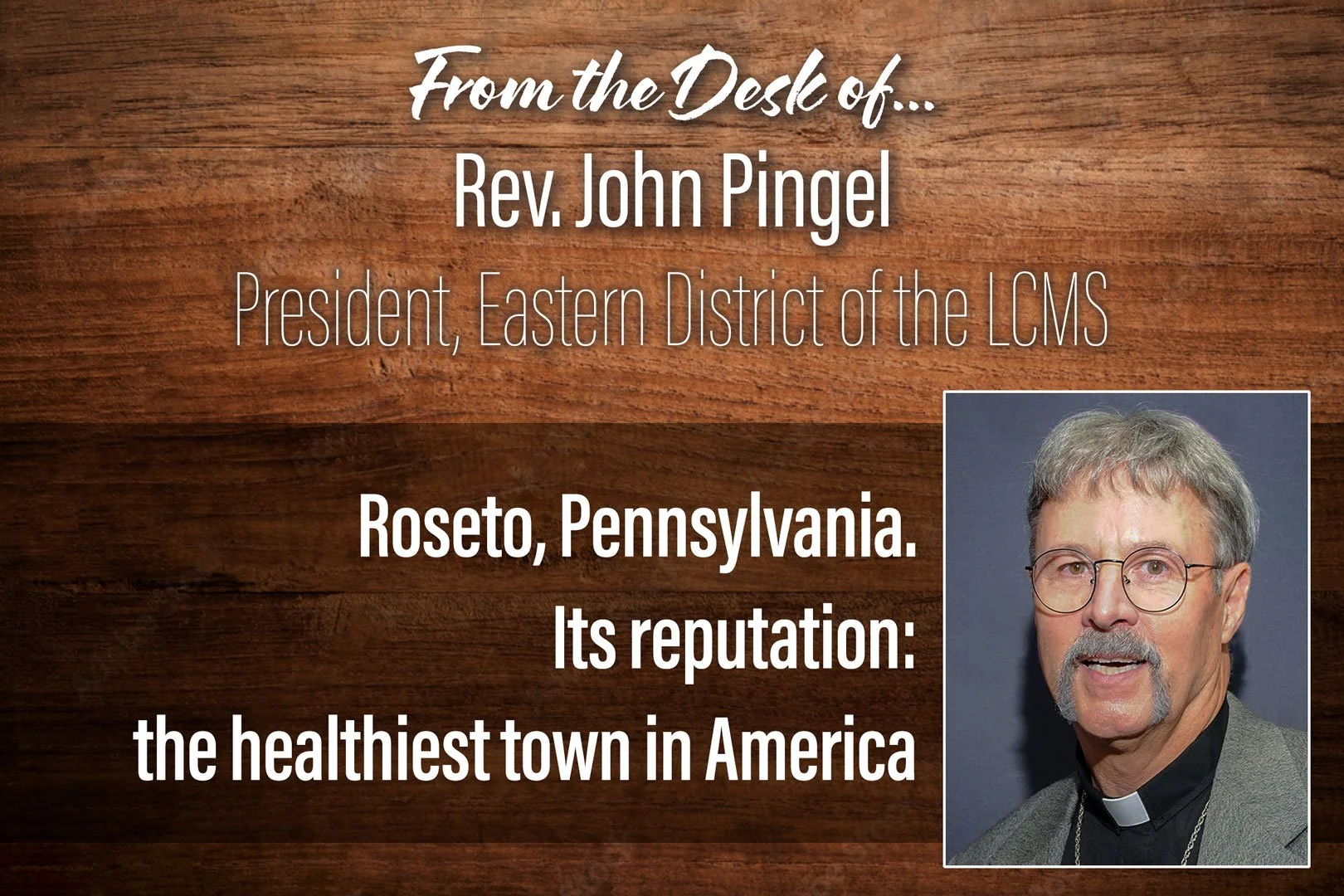
Roseto, Pennsylvania. Its reputation: the healthiest town in America. At the center of that claim is an amazing story.
Many of the inhabitants of the town trace their ancestry to the village of Roseto Valfortore, located 100 miles southeast of Rome. The medieval village centers on a town square and a church named Our Lady of Mt. Carmel. Narrow stone steps run up the hillside flanked by rows of stone houses with red tile roofs. The major industry there: stone quarries, located in the surrounding hills. Villagers would walk 4 to 5 miles each way to work, down the mountain and back, leaving early and returning late.
In 1882, a group of 11 Rosetans set sail for New York City. They spent some time in what is known as “Little Italy,” and then travelled 90 miles west to a location near Bangor, Pennsylvania, in order to work in a slate quarry there.
The initial 11 immigrants were followed by 1,200 more Rosetans over the next few years. They bought land on the rocky hillside and built closely clustered stone houses resembling those they left behind in Italy, only with slate roofs. They also built a church near the center of town, naming it, predictably, “Our Lady of Mt. Carmel.” The church became the center of their social and spiritual life. The town thrived. The Rosetans planted grapes and made homemade wine. They opened bakeries and other small shops. For several decades, the inhabitants spoke mostly Italian, the exact dialect spoken back in Roseto Valliafore. They gathered regularly in social clubs and community centers. They worshiped and celebrated their holidays and holy days and significant events in each other’s lives. They rejoiced together and in times of death and misfortune they grieved together. It was evident that no matter what life brought their way, they were in this together, to love and support each other. No one would suffer alone, no one would live their life alone, no one would die alone.
So what made Roseto, Pennsylvania, remarkable? Simply put, rarely did anyone living in Roseto under the age of 65 get heart disease or die of a heart attack, in contrast to the surrounding towns. The medical community began to take note of this. A physician by the name of Stephen Wolf from the University of Oklahoma launched an investigation into the reason why. This was a time, by the way, before cholesterol lowering drugs and aggressive measures to prevent heart disease. He analyzed physicians’ records. He took medical histories. He studied their diet. In fact, the death rate in Roseto was ½ that of the United States as a whole. Medical clinicians were baffled. What would explain the medical miracle they were observing? Not only was heart disease almost non-existent—there was also hardly any suicide, drug and alcohol addiction, cancer, or ulcers. People simply died of old age. All the while, they ate sausages and pepperoni year round. A full 41% of their diet consisted of fat. Neither diet nor exercise explained their findings. No one ate yogurt or did yoga. Quite a few of the inhabitants, typical of that time period, smoked.
To make a long story short, the answer to the clinicians’ quest lay not in diet or exercise or the location of the town or genetic good fortune. The answer was Roseto itself. The Rosetans had maintained over the years an exceptional sense of community. People knew one another, and they visited with one another frequently. They stopped to chat on the street. They cooked with one another and ate meals with one another. They attended church together and met together in their 22 social clubs. The conclusion of the medical community was that the people of Roseto were exceptionally healthy not for any of the reasons normally associated with maintaining good health—but because of their sense of community. Roseto was a place where people, in the truest sense of the term, “belonged” and were cared about.
Our churches are at their best when they reflect a sense of community, where people love and care for one another. Jesus says in John 13: 35, ‘By this shall all men know that you are my disciples, if ye have love for one another.” “See how they love one another” is a famous quote attributed to the early Christian writer Tertullian in the 3rd century, which in turn quotes pagans observing the early Christians. It refers to the remarkable love, unity, and charitable acts the early Christians displayed toward each other and those in need, which stood out in contrast to the surrounding Greco-Roman culture.
We live in a rather cold and indifferent age. People live next door to one another and never talk. They don’t know who their neighbors are. The medical community maintains that the isolation experienced by many takes its toll on us mentally, emotionally and physically. People self-isolate, and yet surveys show that people at the same time actually crave a sense of community. They want to belong. They want to be cared about and have an opportunity to care for others. They desire to be “connected,” --a desire which appears to have increased in the aftermath of Covid.
The church from its earliest days is described as a community—a community of faith and love, a place where we “bear one another’s burdens” (Galatians 6: 2), where people are “devoted to one another in love.” (Romans 12:10). Acts chapter 2 says that the early Christians “ate together with glad and generous hearts” and “provided for another as any had need.” They knew that the fellowship they enjoyed in the present would continue in eternity (Revelation 7: 9-17), which made it a pretty special thing.
Perhaps you are a small church. You may not have a lot in terms of programming. Sometimes leaders of small churches will say: “What do we have to offer?” My answer is: community. You offer a place where people can find a sense of community. Better still, in this community, at its center, stands the Savior, offering us forgiveness, life and salvation.
So plug in the coffee pot. And have your pot luck suppers. And gather as God gives you opportunity, with a door open to those outside. Invite others. Share the love of Christ. You can be someone’s spiritual Roseto, where people can experience the love of the Savior through you, and find spiritual health and healing in the name of Jesus.
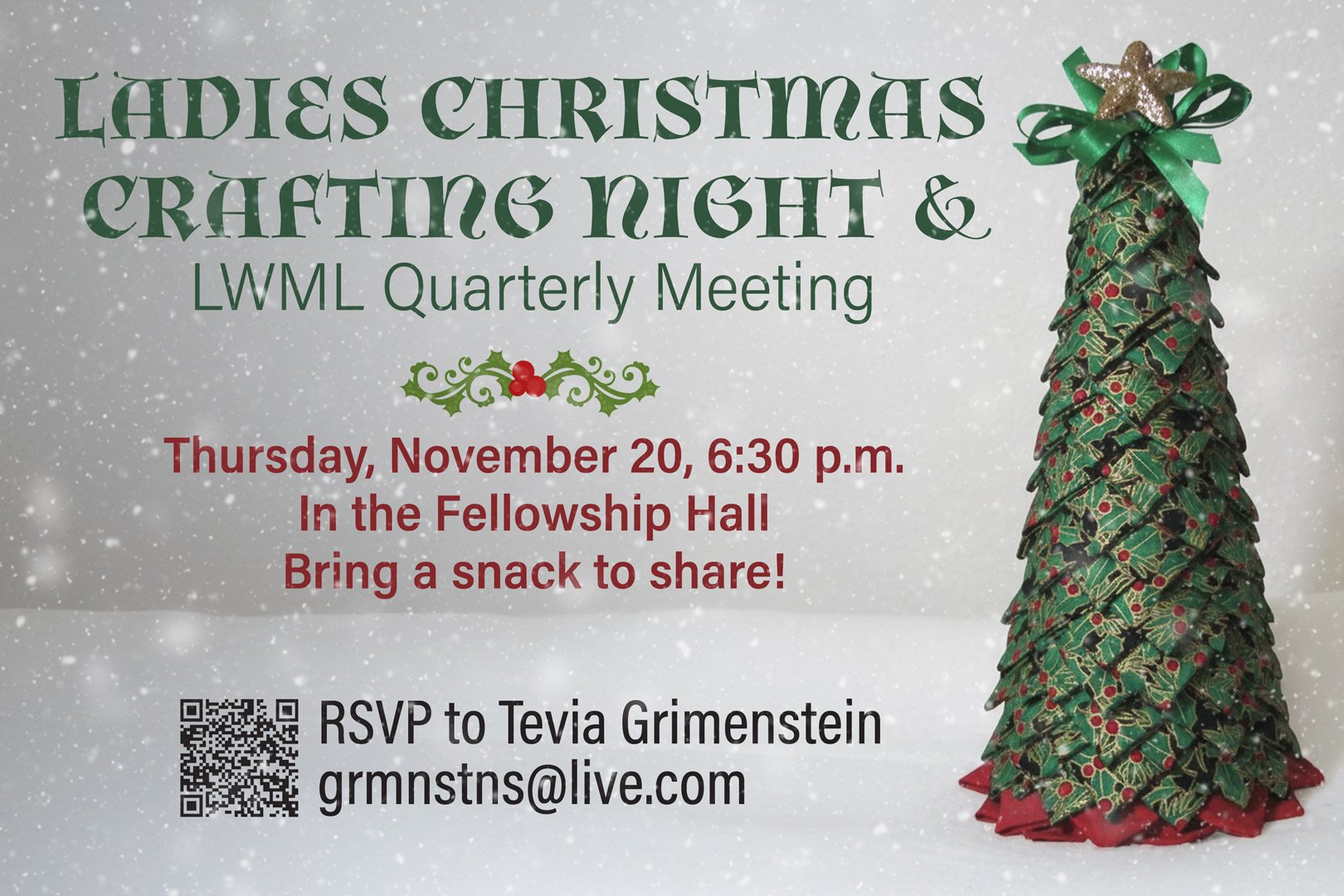
Ladies Christmas Crafting Night & LWML Quarterly Meeting
Ladies Christmas Crafting Night & LWML Quarterly Meeting
Thursday, November 20th at 6:30 p.m.
Happening in Zion Lutheran Church’s Fellowship Hall
Bring a snack to share!
RSVP to Tevia Grimenstein grmnstns@live.com
Ladies Christmas Crafting Night & LWML Quarterly Meeting
Thursday, November 20th at 6:30 p.m.
Happening in Zion Lutheran Church’s Fellowship Hall
Bring a snack to share!
RSVP to Tevia Grimenstein grmnstns@live.com
UPCOMING EVENTS:
December 14
Ornament Exchange
5:00 - 8:30 p.m. @ Napoli’s Bridgeville
June 12-14
LWML District Convention
Lancaster, PA - See Tevial for information
VIDEO: Wednesday, November 12, 2025 - Complete Service
Each service at Zion Lutheran Church (normally the first of our two services) is streamed LIVE on our YouTube channel. This includes Sunday’s, Wednesday’s, Lenten, Advent and special services. The entire service is streamed from beginning-to-end. Weddings and Funerals can also be streamed, if requested in advance.
View the Bulletin for Wednesday, November 12, 2025
Worship Service: 2:00 p.m. with communion
Bible Study: 2:30 p.m. - Psalm 2 with Pastor Grimenstein
All are welcome, bring a friend, neighbor or relative
Visit our YouTube channel — Click the red “subscribe” box, and then click on the “bell” next to that box to receive Live Streaming notifications. You must be logged into YouTube to activate these features.
Archive of AUDIO “Readings & Sermons”
Archive of VIDEO “Complete Service”
Archive of BULLETINS
AUDIO: Readings & Sermon for Wednesday, November 12, 2025
This audio-only file includes all the readings from scripture, along with the sermon — and when available, the announcements, adult choir, men’s choir, and/or bell choir. Also posted along with the audio file is the text for all the scripture readings, and a link to the current bulletin, and our YouTube channel if you prefer to watch the LIVE Stream.
View the Bulletin for Wednesday, November 12, 2025
Worship Service: 2:00 p.m. with communion
Bible Study: 2:30 p.m. - Psalm 2 with Pastor Grimenstein
All are welcome, bring a friend, neighbor or relative
Visit our YouTube channel — Click the red “subscribe” box, and then click on the “bell” next to that box to receive Live Streaming notifications. You must be logged into YouTube to activate these features.
Archive of AUDIO “Readings & Sermons”
Archive of VIDEO “Complete Service”
Archive of BULLETINS
Jeremiah 25:1-18
The word that came to Jeremiah concerning all the people of Judah, in the fourth year of Jehoiakim the son of Josiah, king of Judah (that was the first year of Nebuchadnezzar king of Babylon), which Jeremiah the prophet spoke to all the people of Judah and all the inhabitants of Jerusalem: “For twenty-three years, from the thirteenth year of Josiah the son of Amon, king of Judah, to this day, the word of the LORD has come to me, and I have spoken persistently to you, but you have not listened. You have neither listened nor inclined your ears to hear, although the LORD persistently sent to you all his servants the prophets, saying, ‘Turn now, every one of you, from his evil way and evil deeds, and dwell upon the land that the LORD has given to you and your fathers from of old and forever. Do not go after other gods to serve and worship them, or provoke me to anger with the work of your hands. Then I will do you no harm.’ Yet you have not listened to me, declares the LORD, that you might provoke me to anger with the work of your hands to your own harm.
“Therefore thus says the LORD of hosts: Because you have not obeyed my words, behold, I will send for all the tribes of the north, declares the LORD, and for Nebuchadnezzar the king of Babylon, my servant, and I will bring them against this land and its inhabitants, and against all these surrounding nations. I will devote them to destruction, and make them a horror, a hissing, and an everlasting desolation. Moreover, I will banish from them the voice of mirth and the voice of gladness, the voice of the bridegroom and the voice of the bride, the grinding of the millstones and the light of the lamp. This whole land shall become a ruin and a waste, and these nations shall serve the king of Babylon seventy years. Then after seventy years are completed, I will punish the king of Babylon and that nation, the land of the Chaldeans, for their iniquity, declares the LORD, making the land an everlasting waste. I will bring upon that land all the words that I have uttered against it, everything written in this book, which Jeremiah prophesied against all the nations. For many nations and great kings shall make slaves even of them, and I will recompense them according to their deeds and the work of their hands.”
Thus the LORD, the God of Israel, said to me: “Take from my hand this cup of the wine of wrath, and make all the nations to whom I send you drink it. They shall drink and stagger and be crazed because of the sword that I am sending among them.”
So I took the cup from the LORD's hand, and made all the nations to whom the LORD sent me drink it: Jerusalem and the cities of Judah, its kings and officials, to make them a desolation and a waste, a hissing and a curse, as at this day;
Matthew 26:1-19
When Jesus had finished all these sayings, he said to his disciples, “You know that after two days the Passover is coming, and the Son of Man will be delivered up to be crucified.”
Then the chief priests and the elders of the people gathered in the palace of the high priest, whose name was Caiaphas, and plotted together in order to arrest Jesus by stealth and kill him. But they said, “Not during the feast, lest there be an uproar among the people.”
Now when Jesus was at Bethany in the house of Simon the leper, a woman came up to him with an alabaster flask of very expensive ointment, and she poured it on his head as he reclined at table. And when the disciples saw it, they were indignant, saying, “Why this waste? For this could have been sold for a large sum and given to the poor.” But Jesus, aware of this, said to them, “Why do you trouble the woman? For she has done a beautiful thing to me. For you always have the poor with you, but you will not always have me. In pouring this ointment on my body, she has done it to prepare me for burial. Truly, I say to you, wherever this gospel is proclaimed in the whole world, what she has done will also be told in memory of her.”
Then one of the twelve, whose name was Judas Iscariot, went to the chief priests and said, “What will you give me if I deliver him over to you?” And they paid him thirty pieces of silver. And from that moment he sought an opportunity to betray him.
Now on the first day of Unleavened Bread the disciples came to Jesus, saying, “Where will you have us prepare for you to eat the Passover?” He said, “Go into the city to a certain man and say to him, ‘The Teacher says, My time is at hand. I will keep the Passover at your house with my disciples.’” And the disciples did as Jesus had directed them, and they prepared the Passover.
The Lord’s Prayer – The Fifth Petition
What is the Fifth Petition?
And forgive us our trespasses as we forgive those who trespass against us.
What does this mean?
We pray in this petition that our Father in heaven would not look at our sins, or deny our prayer because of them. We are neither worthy of the things for which we pray, nor have we deserved them, but we ask that He would give them all to us by grace, for we daily sin much and surely deserve nothing but punishment. So we too will sincerely forgive and gladly do good to those who sin against us.