
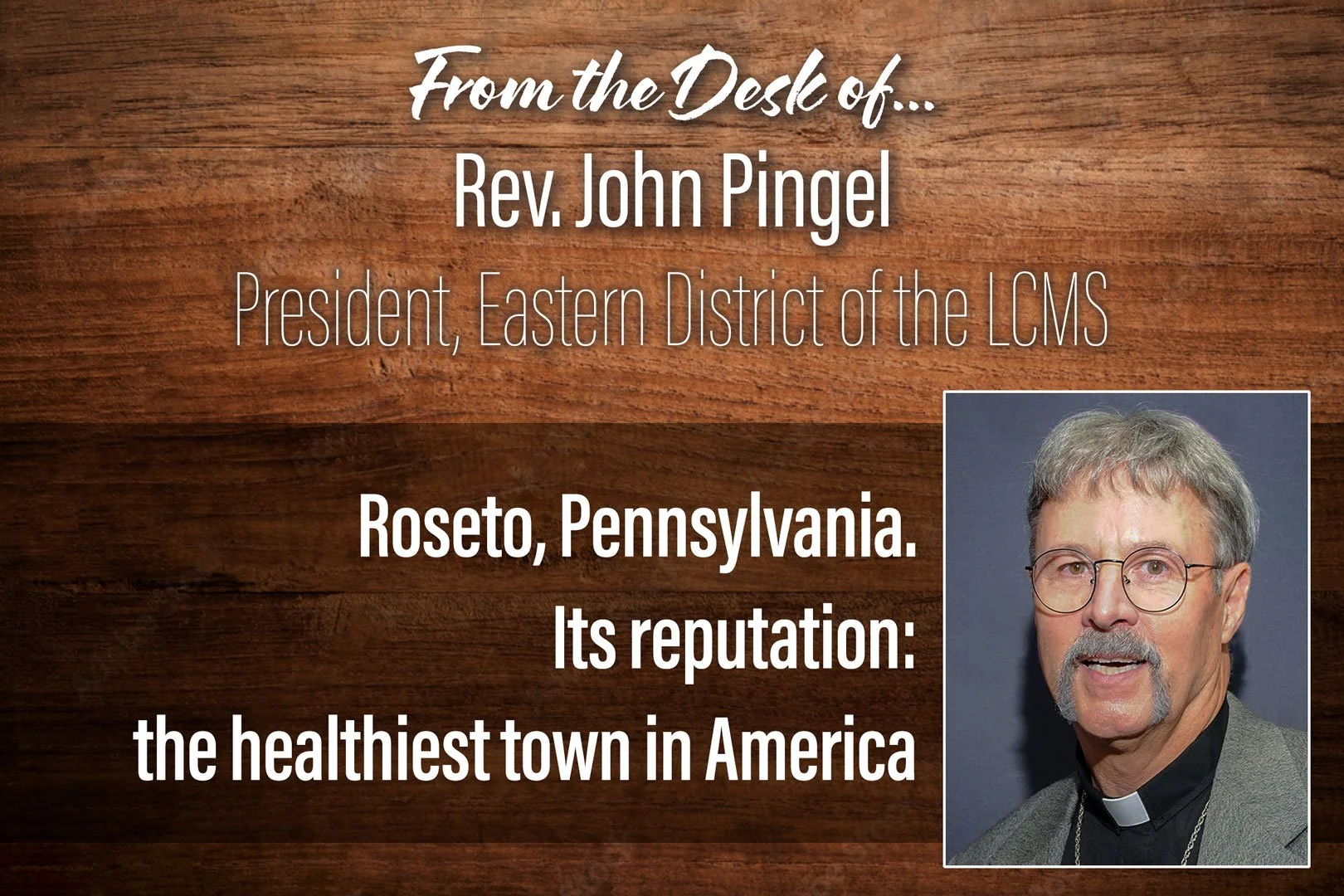
Roseto, Pennsylvania. Its reputation: the healthiest town in America. At the center of that claim is an amazing story.
Many of the inhabitants of the town trace their ancestry to the village of Roseto Valfortore, located 100 miles southeast of Rome. The medieval village centers on a town square and a church named Our Lady of Mt. Carmel. Narrow stone steps run up the hillside flanked by rows of stone houses with red tile roofs. The major industry there: stone quarries, located in the surrounding hills. Villagers would walk 4 to 5 miles each way to work, down the mountain and back, leaving early and returning late.
In 1882, a group of 11 Rosetans set sail for New York City. They spent some time in what is known as “Little Italy,” and then travelled 90 miles west to a location near Bangor, Pennsylvania, in order to work in a slate quarry there.
The initial 11 immigrants were followed by 1,200 more Rosetans over the next few years. They bought land on the rocky hillside and built closely clustered stone houses resembling those they left behind in Italy, only with slate roofs. They also built a church near the center of town, naming it, predictably, “Our Lady of Mt. Carmel.” The church became the center of their social and spiritual life. The town thrived. The Rosetans planted grapes and made homemade wine. They opened bakeries and other small shops. For several decades, the inhabitants spoke mostly Italian, the exact dialect spoken back in Roseto Valliafore. They gathered regularly in social clubs and community centers. They worshiped and celebrated their holidays and holy days and significant events in each other’s lives. They rejoiced together and in times of death and misfortune they grieved together. It was evident that no matter what life brought their way, they were in this together, to love and support each other. No one would suffer alone, no one would live their life alone, no one would die alone.
So what made Roseto, Pennsylvania, remarkable? Simply put, rarely did anyone living in Roseto under the age of 65 get heart disease or die of a heart attack, in contrast to the surrounding towns. The medical community began to take note of this. A physician by the name of Stephen Wolf from the University of Oklahoma launched an investigation into the reason why. This was a time, by the way, before cholesterol lowering drugs and aggressive measures to prevent heart disease. He analyzed physicians’ records. He took medical histories. He studied their diet. In fact, the death rate in Roseto was ½ that of the United States as a whole. Medical clinicians were baffled. What would explain the medical miracle they were observing? Not only was heart disease almost non-existent—there was also hardly any suicide, drug and alcohol addiction, cancer, or ulcers. People simply died of old age. All the while, they ate sausages and pepperoni year round. A full 41% of their diet consisted of fat. Neither diet nor exercise explained their findings. No one ate yogurt or did yoga. Quite a few of the inhabitants, typical of that time period, smoked.
To make a long story short, the answer to the clinicians’ quest lay not in diet or exercise or the location of the town or genetic good fortune. The answer was Roseto itself. The Rosetans had maintained over the years an exceptional sense of community. People knew one another, and they visited with one another frequently. They stopped to chat on the street. They cooked with one another and ate meals with one another. They attended church together and met together in their 22 social clubs. The conclusion of the medical community was that the people of Roseto were exceptionally healthy not for any of the reasons normally associated with maintaining good health—but because of their sense of community. Roseto was a place where people, in the truest sense of the term, “belonged” and were cared about.
Our churches are at their best when they reflect a sense of community, where people love and care for one another. Jesus says in John 13: 35, ‘By this shall all men know that you are my disciples, if ye have love for one another.” “See how they love one another” is a famous quote attributed to the early Christian writer Tertullian in the 3rd century, which in turn quotes pagans observing the early Christians. It refers to the remarkable love, unity, and charitable acts the early Christians displayed toward each other and those in need, which stood out in contrast to the surrounding Greco-Roman culture.
We live in a rather cold and indifferent age. People live next door to one another and never talk. They don’t know who their neighbors are. The medical community maintains that the isolation experienced by many takes its toll on us mentally, emotionally and physically. People self-isolate, and yet surveys show that people at the same time actually crave a sense of community. They want to belong. They want to be cared about and have an opportunity to care for others. They desire to be “connected,” --a desire which appears to have increased in the aftermath of Covid.
The church from its earliest days is described as a community—a community of faith and love, a place where we “bear one another’s burdens” (Galatians 6: 2), where people are “devoted to one another in love.” (Romans 12:10). Acts chapter 2 says that the early Christians “ate together with glad and generous hearts” and “provided for another as any had need.” They knew that the fellowship they enjoyed in the present would continue in eternity (Revelation 7: 9-17), which made it a pretty special thing.
Perhaps you are a small church. You may not have a lot in terms of programming. Sometimes leaders of small churches will say: “What do we have to offer?” My answer is: community. You offer a place where people can find a sense of community. Better still, in this community, at its center, stands the Savior, offering us forgiveness, life and salvation.
So plug in the coffee pot. And have your pot luck suppers. And gather as God gives you opportunity, with a door open to those outside. Invite others. Share the love of Christ. You can be someone’s spiritual Roseto, where people can experience the love of the Savior through you, and find spiritual health and healing in the name of Jesus.