
Youth Group Fundraiser: Mardi Gras Dinner
Mardi Gras Dinner
March 4, 2025 at 6:30 p.m.
$20/Adults and $10/Children
Enjoy a New Orleans-style meal while raising money to send Zion’s youth to the LCMS Youth Gathering in New Orleans this year.

Mardi Gras Dinner
March 4, 2025 at 6:30 p.m.
$20/Adults and $10/Children
Enjoy a New Orleans-style meal while raising money to send Zion’s youth to the LCMS Youth Gathering in New Orleans this year.
Woman’s Book Club: Spring Book & Meeting
Woman’s Book Club
Spring Book & Meeting: ”Men Called Him Master”
by Elwyn A. Smith
Thursday, March 20, 2025 at 6:30 p.m. in Zion’s Conference Room. Bring a treat to Share!
Use this link to download the book free from Amazon/Kindle
Quesitons? contact Tevia or Joanna
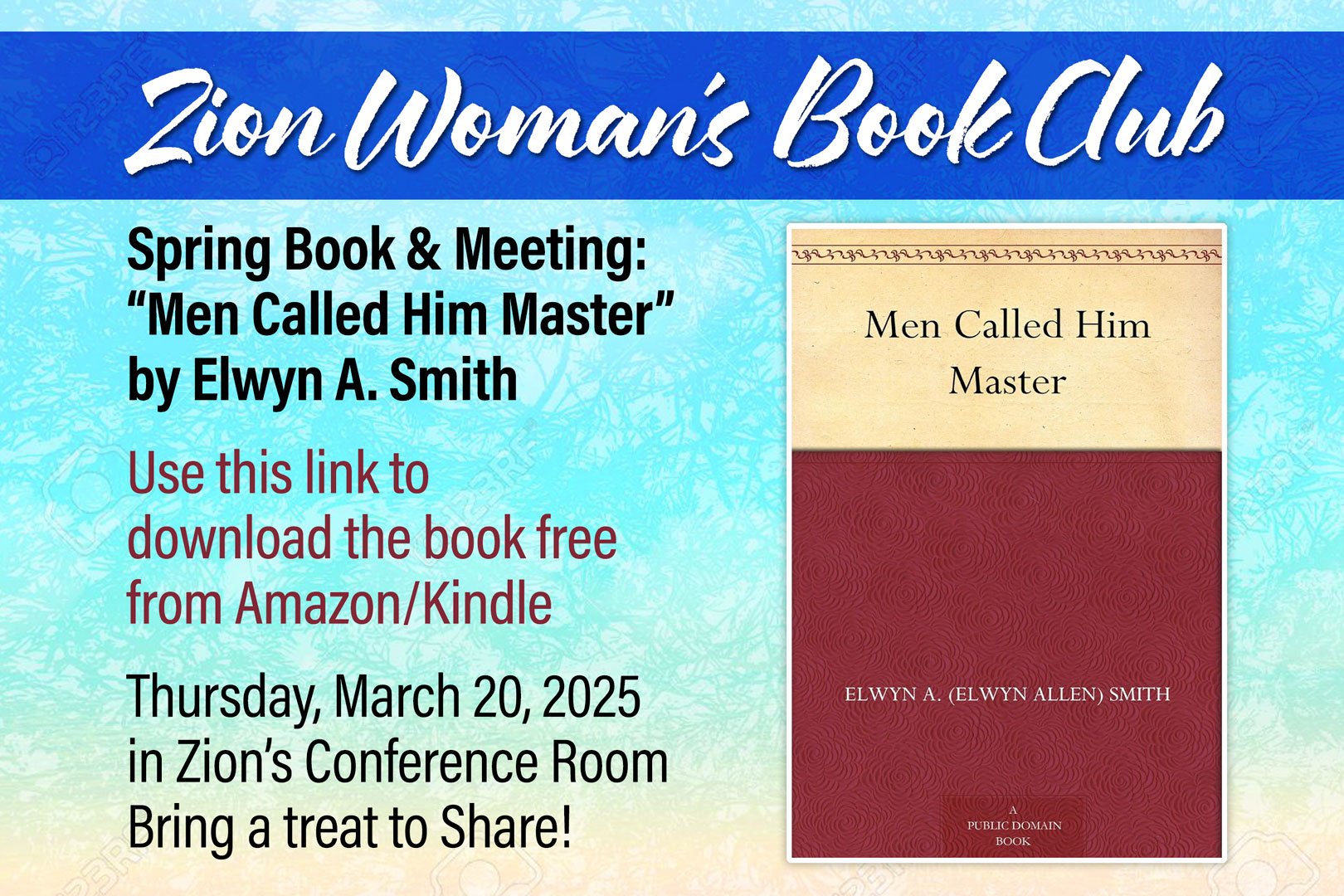
Woman’s Book Club
Spring Book & Meeting: ”Men Called Him Master”
by Elwyn A. Smith
Thursday, March 20, 2025 in Zion’s Conference Room
Bring a treat to Share!
Use this link to download the book free from Amazon/Kindle
Quesitons? contact Tevia or Joanna
From the Book Club Stacks … Re-read a book club favorite!
‘Unbelievable’ loss: Historic First Lutheran finds strength in God, church
‘Unbelievable’ loss: Historic First Lutheran finds strength in God, church
LOS ANGELES – On Jan. 7, a wildfire broke out in the foothills of Angeles National Forest, just north of Altadena, Calif. The Santa Ana winds, blowing at record speeds, rapidly spread the flames. Within hours, entire neighborhoods in Altadena were ablaze.
The Eaton fire would become the second most destructive wildfire in California history, burning over 9,000 structures and displacing tens of thousands of people. Together with the Palisades fire, which began on the same day 30 miles to the southwest, the two wildfires would burn nearly 60 square miles and leave 29 people dead.
As of Feb. 1, almost a month after they began, the Eaton fire and the Palisades fire are both 100% contained.
Click below to read the complete story …

A corner in Altadena, Calif., reflects the devastating effects of the Eaton wildfire on Wednesday, Jan. 29. The fire, which began on Jan. 7, is now 100% contained. (LCMS/Sarah Hjulberg)
From LCMS’ “Reporter by Sarah Hjulberg
LOS ANGELES – On Jan. 7, a wildfire broke out in the foothills of Angeles National Forest, just north of Altadena, Calif. The Santa Ana winds, blowing at record speeds, rapidly spread the flames. Within hours, entire neighborhoods in Altadena were ablaze.
The Eaton fire would become the second most destructive wildfire in California history, burning over 9,000 structures and displacing tens of thousands of people. Together with the Palisades fire, which began on the same day 30 miles to the southwest, the two wildfires would burn nearly 60 square miles and leave 29 people dead.
As of Feb. 1, almost a month after they began, the Eaton fire and the Palisades fire are both 100% contained.
“Grieving with those who grieve”
Pauline Daniels was with her elderly mother, Shelly Daniels, when she saw a police car go down the street. She heard only the tail-end of an announcement the officer was making over a megaphone. Then, a neighbor filled the Daniels in: they needed to evacuate. Thankfully, the next day both Shelly and Pauline heard that their homes had escaped the fire — Shelly’s thanks to a neighbor who stayed behind to keep the fire at bay with a garden hose.
The only warning Harriet and Michael Dickens received was a neighbor’s knock at the door in the middle of the night. The power was out, so they had trouble finding the essentials, but they grabbed what they could and fled. The next morning, they found out their 100-year-old home had burned.
Bernadette Hendry stopped by the grocery store on her way home from work in Pasadena. “I’m driving home, and I just see this orange sky,” she said. Within about an hour of getting home, she and her husband, Greg, got evacuation notices on their phones.
“All my groceries are now in ashes,” Hendry continued. They heard the next day their home of nearly 30 years was gone.
“For me as pastor, there was a total feeling for about the first four days of total helplessness,” said the Rev. Christopher Schaar, pastor of Historic First Lutheran Church in Pasadena, Calif., where the Daniels, the Dickens and the Hendrys are all longtime members. “There was absolutely nothing anybody could do, and [everything] just seemed so unbelievable.”
All in all, six families at First Lutheran lost their homes, and an additional six families (who are former members or immediate family of current members) have also had total losses. One former student of First Lutheran’s school died in the fire.
As they grieve the loss of their homes, many of these families also grieve the loss of their neighborhood: Altadena’s historically Black community is a tight-knit place, where most residents — and generations of families — had lived for decades. For instance, four generations of the Daniels family, many of whom have been baptized, confirmed and married at First Lutheran, all live in Altadena. Three of the five homes in their family were destroyed.
“Yet I will praise Him”
On Sunday, Jan. 12, just days after the fire, God’s people gathered in record numbers for worship at First Lutheran, including members who had lost their homes.
“Remember when the young Jesus was in the temple and His earthly parents were looking for Him?” said Harriet Dickens. “He said, ‘I was in my Father’s house.’ So we knew we had to go to our Father’s house, where we could be loved, prayed for, supported.”
“[I’ve been] encouraging [the congregation] that we need to be together around Word and Sacrament,” said Schaar. “People are recognizing that we need to be together at a time like this, and, as Scripture says, to grieve with those who grieve and to rejoice with those who rejoice.”
Schaar said that Psalm 42:5, “Yet I will praise Him,” continually comes to mind. “The psalms are just full of that refrain. It seems like every single psalm talks about some kind of tragedy. And yet, ‘I will praise Him!’ … God is going to be at work through all this in some way.”
In the four weeks since the fire, God has been at work through His people: Schaar said he has seen his congregation come together and be the Body of Christ to each other in many ways, such as cooking meals for each other, helping victims with insurance paperwork, and replacing Bibles for members who lost theirs in the fire. The congregation has also given generous financial support to their members who lost houses, as well as to another family who lost their livelihood in the fire.
“The church is a family,” said Johnnie Douglas, who is a former Lutheran school teacher and an alumnus of Concordia Teacher’s College in Seward, Neb., now Concordia University, Nebraska. Her home was also destroyed by the fire.

The Rev. Dr. Ross Johnson (right), director of LCMS Disaster Response, meets with the Rev. Christopher Schaar, pastor of Historic First Lutheran Church, Pasadena, Calif., in front of the burnt remains of a member’s home on Jan. 29 in Altadena, Calif. (LCMS/Sarah Hjulberg)
Response efforts underway
The congregation has also raised thousands of dollars to purchase Target and Visa gift cards to help victims (both their own members and those in the community) kickstart the process of replacing lost belongings.
“When I give the gift cards to our members,” said Schaar, “I say, ‘When you give this to your friends, tell them it comes from your church, and that we care about them. Whatever needs you have, we’ll try to meet them, physically as well as spiritually.”
LCMS Disaster Response provided an additional $10,000 in Visa gift cards so the church could continue to support their community, as well as an initial $25,000 grant to help with emergency rehousing needs.
Many of First Lutheran’s families plan to rebuild. The Daniels, Hendrys, Dickens and Johnnie Douglas all said their insurance companies have been helpful and supportive so far. But in the meantime, semi-permanent housing is a serious need.
“All of L.A. County has been in a severe housing crisis for years, especially affordable housing. I don’t know where 8,000 or 9,000 households of people are going to go,” said Schaar.
The Rev. Dr. Ross Johnson, director of LCMS Disaster Response, is also working with Schaar to come up with a plan so that renters, homeowners who don’t have house insurance, or other underserved people don’t fall through the cracks as recovery efforts progress.
Johnson was also able to visit the congregation and provide spiritual care to fire victims. “We look forward to the resurrection, not to the things of this world, to find comfort,” he told First Lutheran members before praying with them. “Forgiveness isn’t based on how I feel or what is going on in my life, but on the promises of Jesus.”
Support the response
LCMS Disaster Response
LCMS Pacific Southwest District
New Bible Study Starting Sunday February 16th
Join us for Bible study this Sunday at 9:15 a.m. in the Fellowship Hall as we dive into a new book … St. Paul's first letter to the Corinthians!
Grab a cup of coffee or juice, enjoy a donut or bagel, and study God's Word with your brothers & sisters at Zion!

Join us for Bible study this Sunday at 9:15 a.m. in the Fellowship Hall as we dive into a new book
St. Paul's first letter to the Corinthians!
Grab a cup of coffee or juice, enjoy a donut or bagel, and study God's Word with your brothers & sisters at Zion!
Bulletin: Sunday February 16, 2025 + This Week at Zion
Download/view the latest bulletin. It’s filled with our hymns, the order of service, all the readings from scripture, prayer requests for family & friends, service participants, communion statement, about our worship, the schedule of events for this coming weeks, along with announcements, news updates, happenings, and more!

View the bulletin for Sunday, February 16, 2025
Archive of AUDIO “Readings & Sermons”
Archive of VIDEO “Complete Service”
Archive of Bulletins
THIS WEEK AT ZION
Saturday February 15
No Events Scheduled
Sunday February 16
8:00 a.m. — Worship Service with Communion
9:15 a.m. — Adult/Teen Bible Study & Sunday School
10:30 a.m. — Worship Service with Communion
6:00 p.m. — Parent’s Night Out — Youth Group Fundraiser (Details)
(The 8:00 a.m. service streamed on our YouTube channel)
Monday February 17
6:00 p.m. - Confirmation
6:00 p.m. - Grace Bell Choir Practice
7:00 p.m. - Confirmation
Tuesday February 18
6:15 p.m. - Faith Bell Choir Practice
7:15 p.m. - Adult Choir Practice
Wednesday February 19
2:00 p.m. - Mid-Week Worship Service
2:30 p.m. - 30 min. Bible Study
(Service streamed on our YouTube channel)
Thursday February 20
No Events Scheduled
Friday February 21
No Events Scheduled
Saturday February 22
No Events Scheduled
Sunday February 23
8:00 a.m. — Worship Service with Communion
9:15 a.m. — Adult/Teen Bible Study & Sunday School
10:30 a.m. — Worship Service with Communion
(The 8:00 a.m. service streamed on our YouTube channel)

CLICK THE UPCOMING EVENTS GRAPHIC to go directly to our UPCOMING EVENTS page
Volunteers Needed for VBS 2025
Vacation Bible School Week is …
Monday July 7th through Friday July 11th from 9:00 a.m. to 11:30 a.m.
We hope you can join us in the Australian outback! Volunteers are needed.
Volunteer Opportunities:
There are lots of opportunities to help in hands-on roles with kids, and with behind-the-scenes tasks! Volunteer all five days, or less to fit your schedule. Go to Zion's VBS webpage and click the Volunteer Form to sign up!
Student Registration will open in March … stay tuned!
Join us on an unforgettable journey with Jesus as we venture through Australia! During Vacation Bible School 2025 we will go on an Epic Australian Adventure and experience five unforgettable stories about Jesus.

Vacation Bible School Week is …
Monday July 7th through Friday July 11th from 9:00 a.m. to 11:30 a.m.
We hope you can join us in the Australian outback! Volunteers are needed.
Volunteer Opportunities:
There are lots of opportunities to help in hands-on roles with kids, and with behind-the-scenes tasks! Volunteer all five days, or less to fit your schedule. Go to Zion's VBS webpage and click the Volunteer Form to sign up … or use the button below!
Student Registration will open in March … stay tuned!
Join us on an unforgettable journey with Jesus as we venture through Australia! During Vacation Bible School 2025 we will go on an Epic Australian Adventure and experience five unforgettable stories about Jesus.
Effective Outreach (Part 4 of 4)
EFFECTIVE OUTREACH Provides Appropriate and Appealing Entry Points into Word and Sacrament Ministry
(Part 4 our 4)
This four-part series on Effective Outreach has addressed the three things that make up effective outreach. After we have found ways to create connections and build relationships with nonchurched people, we are well positioned to invite them to join us in the spiritual life of the congregation.
Click on the link below to read the complete story …

By Rev. Dr. Mark Wood, LCMS Managing Director
This four-part series on Effective Outreach has addressed the three things that make up effective outreach. After we have found ways to create connections and build relationships with nonchurched people, we are well positioned to invite them to join us in the spiritual life of the congregation.
The definition of effective outreach puts it this way:
Effective outreach is the “planting and watering” (cf. 1 Corinthians 3:5-9) through which a congregation intentionally engages nonchurched people in ways that … offer appropriate and appealing entry points (other than worship services and traditional Bible studies) that encourage nonchurched people to participate in the Word and Sacrament ministry* of the congregation.
*Word and Sacrament ministry refers to the various ways in which congregations share the good gifts of God given to us in His Word and through His Sacraments.
This definition is built on two very important things:
The first, and most important, is the understanding that disciples are made by the Holy Spirit working through the Means of Grace (i.e., through the Word and the Sacraments).
The second — which is far too often overlooked by us — is that we need to offer nonchurched people ways to enter into the Word and Sacrament ministry of our congregation which they find interesting and appealing. Most churched people realize that nonchurched people see things differently than we do. With that in mind, it shouldn’t surprise us when nonchurched people don’t see our congregation the same way that we do.
We know it as a spiritual home filled with a family of faith and caring friends. We know it to be a refuge from the despair of the world and a place of hope. They see it as a building filled with strangers who have some unusual beliefs and practices. More and more they see it as a place of judgment, intolerance, and phobias. Making the effort to build relationships with nonchurched people goes a long way to helping them see the church in a positive way.
But even having a positive view of the church isn’t enough for many nonchurched people to overcome their fear of attending a worship service or the intimidation of joining a traditional Bible study. Fear? Intimidation? We aren’t afraid of worship or intimidated by Bible studies, true, but many nonchurched people are. Even the strength of good relationships with members of the congregation may not be enough for nonchurched people to overcome their fears and uncertainties.
It is up to us to provide ways into the Word and Sacrament ministry of our congregation that ease their fears and keep them from being intimidated. That’s what is meant by “appropriate and appealing entry points” into Word and Sacrament.
It’s important to maintain the “appropriate” part of this equation. The most appropriate entry point into Word and Sacrament ministry for most people is joining us in hearing and learning about God’s Word. “Appropriate” also means guarding against turning the church into a marketplace that caters to the consumer demands of people — churched or nonchurched. But let’s not underestimate the importance of the “appealing” part. Properly understood, “appealing” calls us to consider the other person’s point-of-view.
Let me be very clear that this is NOT about worship style.
Changing to, or adding, a contemporary worship service is not what it takes to provide appealing entry points into the spiritual life of a congregation. (That’s why our definition says “other than worship services or traditional Bible studies.”)
Worship, in any form or style, is not an issue for nonchurched people (though it certainly can be for churched people). Nonchurched people do not stay away from churches because of how we worship; they stay away because we do worship and they don’t. More than that, they can’t worship the Lord. How could they? They cannot call on the name of the One whom they do not know.
This reminds us that the Church has what people desperately need, so desperately that they are perishing without it. Yet, there is little about the Church — worship or otherwise — that is very appealing from an outsider’s perspective. Changing that perspective in order to encourage nonchurched people to join us in hearing God’s word isn’t complicated or difficult. It centers on a question that we need to answer honestly: Do we care enough about the nonchurched people in our community to stretch ourselves to bring the Gospel to them in creative ways? Another question we should ask ourselves is: Are we so comfortable with our ways of doing things that we are apathetic about the needs of those who are perishing?
This boils down to a critical choice: Risk being uncomfortable in order to serve others OR stay comfortable and ignore those who are perishing.
We may not like thinking about it this way, but that’s the choice before us. By the grace of God and in the love of Jesus, we are willing to stretch ourselves for the sake of others. But how do we do it? It starts with considering the perspective of nonchurched people before inviting them to join us in sharing God’s good gifts — in ways other than worship services and traditional Bible studies. It calls for us to step back and look at what we’re doing with fresh eyes. It involves faithfully managing the tension between maintaining what has been handed down to us and responding to the ever-changing context of the world around us. But mostly it is purposefully working to offer God’s good gifts in creative ways that engage people who don’t know the love, joy, and peace of Jesus.
Questions to consider:
What entry points into Word and Sacrament ministry does our congregation currently offer that are specifically designed to be of interest to nonchurched people?
What can we do to better understand how nonchurched people view our church?
What could we change about how we do things to be more appealing to nonchurched people? How could we change it?
What should we not change about what we do or how we do it even though it may be unappealing to nonchurched people? Why shouldn’t we change it?