

Women’s Ministries: Save the Dates
Zion Women’s Ministries Save the Dates:
Saturday, July 30, 2024
LWML Prayer Service
(Additional Details)
Thursday, September 19th
Ladies Dinner to welcome Deaconness Joanna Lee
September 20-22nd
Eastern District LWML Fall Retreat at Camp Pioneer
(Additional Details)

Zion Women’s Ministries Save the Dates:
Saturday, July 30, 2024
LWML Prayer Service (Additional Details)
Thursday, September 19th
Ladies Dinner to welcome Deaconness Joanna Lee
September 20-22nd
Eastern District LWML Fall Retreat at Camp Pioneer (Additional Details)
Seven Elements of Stewardship
The LCMS has defined stewardship as “the free and joyous activity of God’s family — the church — in managing life’s resources for His purposes.” Here are seven elements of stewardship:
Stewardship is free
Stewardship is joyous
Stewardship is the work of the church
Stewardship includes time
Stewardship includes people
Stewardship includes finances
Stewardship is about God’s purposes
God made us for this stewardship. We failed. In Christ He has redeemed and restored us to this task. We don’t deserve it in any way. But we are free. This freedom is the initiation of our joy. This joy is what leads us to be faithfully active as stewards of all that God entrusts to us for the sake of the Gospel and the benefit and salvation of our neighbor.
Use the link below to read the entire article
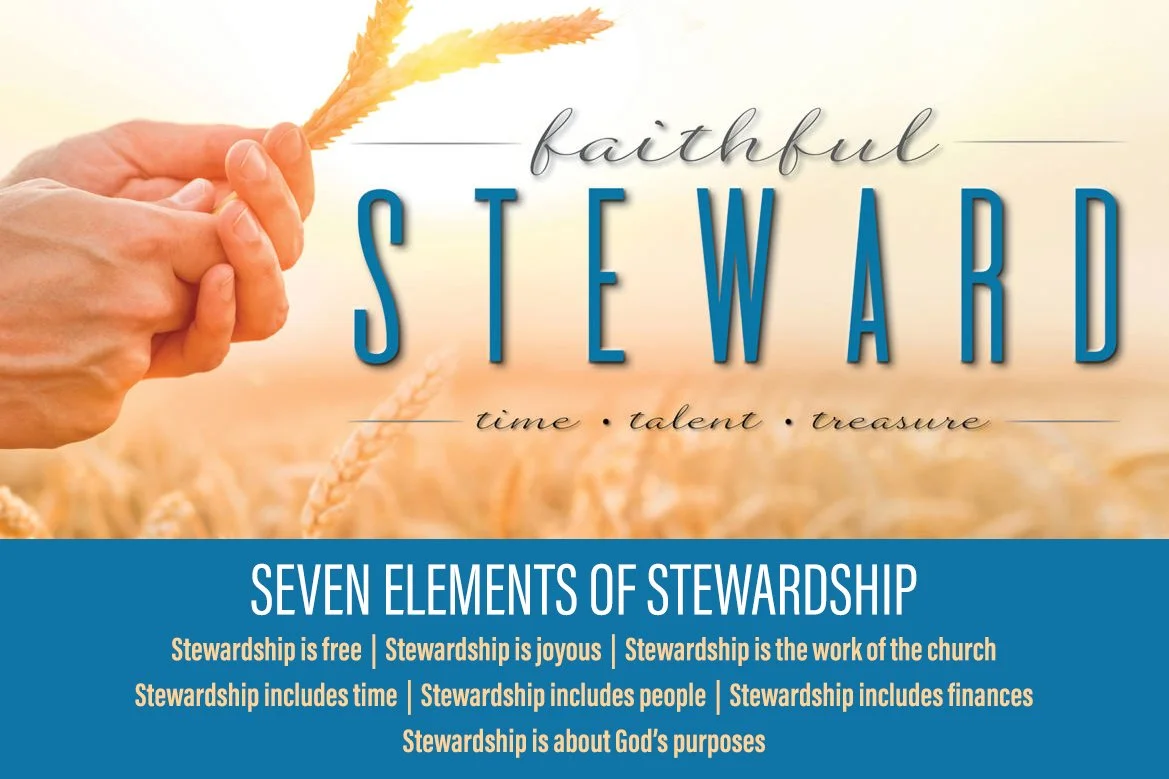
The LCMS has defined stewardship as “the free and joyous activity of God’s family — the church — in managing life’s resources for His purposes.” Here are seven elements of stewardship:
Stewardship is free.
This means is it without compulsion. While Scripture speaks of the tithe, to turn it into law is to miss the point! Stewardship is not a system of taxation used by the church to survive and pay the bills. Stewards are created in the image of God to manage creation, and redeemed and reconciled to God by the blood of Jesus to be stewards of ministry of the Gospel. However, our stewardship is not our creation. It is the Holy Spirit at work in and through us. This is what makes it truly free. We are simply conduits of the work of the Spirit as we steward the work of the Gospel through the local congregation, district, and Synod.
Stewardship is joyous.
There isn’t anything sad about doing what we were created to be and do. The faithfulness which the Spirit works in us is used to bring and keep people in the faith. The cheerful giver of whom Paul speaks in 2 Corinthians rejoices not in what he does, rather in what the Lord does through him.
Stewardship is the work of the church.
Stewardship is more than just a “me and Jesus” thing. While each person and family are led by the Spirit to set aside what they give on the first day of the week, when it is done in the setting of the Divine Service the Body is working together for the sake of the Gospel. Like the human body, stewardship is so much more than the sum of its parts.
Stewardship includes time.
Time is the single most finite resource entrusted to the individual steward. No amount of timesaving, productivity-increasing strategies will ever add one moment to the week entrusted to the steward. The church and the individual steward must faithfully manage this most finite of resources.
Stewardship includes people.
Individual Christian stewards are the ones who have that finite resource of time entrusted to them. It is crucial that the local congregation is faithful in its management of the time of every member of the Body of Christ. If we invest time and effort in things that do not flow from our true purpose of the stewardship of the Gospel, we are not being faithful. This will rob our people of their freedom and their joy. For this reason, it is critical that WHAT the congregation does and HOW they do it all flows from a knowledge of WHY they are placed there by the Lord of the Church.
Stewardship includes finances.
This is indeed the least finite of the resources entrusted to the steward and to God’s family of the church. I learned this lesson firsthand from a faithful Lutheran farmer decades ago. My wife and I were looking at purchasing land and building a house. When we approached a member about purchasing a section of long abandoned pasture on which we would build, the response came, “Pastor, we love you. But we can always make more money. God’s not going to make any more dirt.” Congregations can always find ways to increase what comes into the congregation in offerings and be more faithful with what is already entrusted. While it is critical that we are indeed faithful with what is entrusted, we dare not make the least finite resource the biggest deal!
Stewardship is about God’s purposes.
This is what sets Christian stewardship apart from any other kind of stewardship. Worldly stewardship flows from fear. If we are not faithful in our stewardship of the air, water and land, fear says we are going to die! But the Christian steward seeks to be faithful in every aspect of creation because it was created by God and redeemed in the blood of Jesus. Our stewardship flows not from fear but from faith. This faith is driven by the promise of God’s purpose. God’s purpose is that the church’s faithful stewardship be an instrument of His purpose that all people come to the knowledge of the truth and be saved. Our stewardship of the Gospel is central and instrumental in this!
God made us for this stewardship. We failed. In Christ He has redeemed and restored us to this task. We don’t deserve it in any way. But we are free. This freedom is the initiation of our joy. This joy is what leads us to be faithfully active as stewards of all that God entrusts to us for the sake of the Gospel and the benefit and salvation of our neighbor.
– Mike Kroeger, Elder
Distilled from an article by Nathan Meador in The Lutheran Witness, Mar 7, 2024
VIDEO: Wednesday July 24, 2024 - Complete Service
Each service at Zion Lutheran Church (normally the first of our two services) is streamed LIVE on our YouTube channel. This includes Sunday’s, Wednesday’s, Lenten, Advent and special services. The entire service is streamed from beginning-to-end. Weddings and Funerals can also be streamed, if requested in advance.

View the Bulletin for Wednesday, July 24, 2024
Worship Service: 2:00 p.m.
Bible Study: 2:30 p.m. — The Book of Hebrews
All are welcome, bring a friend, neighbor or relative
Visit our YouTube channel — Click the red “subscribe” box, and then click on the “bell” next to that box to receive Live Streaming notifications. You must be logged into YouTube to activate these features.
Archive of AUDIO “Readings & Sermons”
Archive of VIDEO “Complete Service”
Archive of BULLETINS
AUDIO: Readings & Sermon for Wednesday July 24, 2024
This audio-only file includes all the readings from scripture, along with the sermon — and when available, the announcements, adult choir, men’s choir, and/or bell choir. Also posted along with the audio file is the text for all the scripture readings, and a link to the current bulletin, and our YouTube channel if you prefer to watch the LIVE Stream.
View the Bulletin for Wednesday, July 24, 2024
Worship Service: 2:00 p.m.
Bible Study: 2:30 p.m. — The Book of Hebrews
All are welcome, bring a friend, neighbor or relative
Visit our YouTube channel — Click the red “subscribe” box, and then click on the “bell” next to that box to receive Live Streaming notifications. You must be logged into YouTube to activate these features.
Archive of AUDIO “Readings & Sermons”
Archive of VIDEO “Complete Service”
Archive of BULLETINS
1 Samuel 8:1-22
When Samuel grew old, he appointed his sons as Israel’s leaders. The name of his firstborn was Joel and the name of his second was Abijah, and they served at Beersheba. But his sons did not follow his ways. They turned aside after dishonest gain and accepted bribes and perverted justice.
So all the elders of Israel gathered together and came to Samuel at Ramah. They said to him, “You are old, and your sons do not follow your ways; now appoint a king to lead us, such as all the other nations have.”
But when they said, “Give us a king to lead us,” this displeased Samuel; so he prayed to the LORD. And the LORD told him: “Listen to all that the people are saying to you; it is not you they have rejected, but they have rejected me as their king. As they have done from the day I brought them up out of Egypt until this day, forsaking me and serving other gods, so they are doing to you. Now listen to them; but warn them solemnly and let them know what the king who will reign over them will claim as his rights.”
Samuel told all the words of the LORD to the people who were asking him for a king. He said, “This is what the king who will reign over you will claim as his rights: He will take your sons and make them serve with his chariots and horses, and they will run in front of his chariots. Some he will assign to be commanders of thousands and commanders of fifties, and others to plow his ground and reap his harvest, and still others to make weapons of war and equipment for his chariots. He will take your daughters to be perfumers and cooks and bakers. He will take the best of your fields and vineyards and olive groves and give them to his attendants. He will take a tenth of your grain and of your vintage and give it to his officials and attendants. Your male and female servants and the best of your cattle and donkeys he will take for his own use. He will take a tenth of your flocks, and you yourselves will become his slaves. When that day comes, you will cry out for relief from the king you have chosen, but the LORD will not answer you in that day.”
But the people refused to listen to Samuel. “No!” they said. “We want a king over us. Then we will be like all the other nations, with a king to lead us and to go out before us and fight our battles.”
When Samuel heard all that the people said, he repeated it before the LORD. The LORD answered, “Listen to them and give them a king.”
Then Samuel said to the Israelites, “Everyone go back to your own town.”
Acts 21:15-36
After this, we started on our way up to Jerusalem. Some of the disciples from Caesarea accompanied us and brought us to the home of Mnason, where we were to stay. He was a man from Cyprus and one of the early disciples.
When we arrived at Jerusalem, the brothers and sisters received us warmly. The next day Paul and the rest of us went to see James, and all the elders were present. Paul greeted them and reported in detail what God had done among the Gentiles through his ministry.
When they heard this, they praised God. Then they said to Paul: “You see, brother, how many thousands of Jews have believed, and all of them are zealous for the law. They have been informed that you teach all the Jews who live among the Gentiles to turn away from Moses, telling them not to circumcise their children or live according to our customs. What shall we do? They will certainly hear that you have come, so do what we tell you. There are four men with us who have made a vow. Take these men, join in their purification rites and pay their expenses, so that they can have their heads shaved. Then everyone will know there is no truth in these reports about you, but that you yourself are living in obedience to the law. As for the Gentile believers, we have written to them our decision that they should abstain from food sacrificed to idols, from blood, from the meat of strangled animals and from sexual immorality.”
The next day Paul took the men and purified himself along with them. Then he went to the temple to give notice of the date when the days of purification would end and the offering would be made for each of them.
When the seven days were nearly over, some Jews from the province of Asia saw Paul at the temple. They stirred up the whole crowd and seized him, shouting, “Fellow Israelites, help us! This is the man who teaches everyone everywhere against our people and our law and this place. And besides, he has brought Greeks into the temple and defiled this holy place.” (They had previously seen Trophimus the Ephesian in the city with Paul and assumed that Paul had brought him into the temple.)
The whole city was aroused, and the people came running from all directions. Seizing Paul, they dragged him from the temple, and immediately the gates were shut. While they were trying to kill him, news reached the commander of the Roman troops that the whole city of Jerusalem was in an uproar. He at once took some officers and soldiers and ran down to the crowd. When the rioters saw the commander and his soldiers, they stopped beating Paul.
The commander came up and arrested him and ordered him to be bound with two chains. Then he asked who he was and what he had done. Some in the crowd shouted one thing and some another, and since the commander could not get at the truth because of the uproar, he ordered that Paul be taken into the barracks. When Paul reached the steps, the violence of the mob was so great he had to be carried by the soldiers. The crowd that followed kept shouting, “Get rid of him!”
The Sacrament of the Altar
Who receives this Sacrament worthily?
Fasting and bodily preparation are certainly fine outward training. But that person is truly worthy and well prepared who has faith in these words: “Given and shed for you for the forgiveness of sins.”
But anyone who does not believe these words or doubts them is unworthy and unprepared, for the words “for you” require all hearts to believe.
Bulletin: Wednesday July 24, 2024
View the Wednesday Bulletin for July 17, 2024
Click to download the Wednesday Bulletin which includes all of the scripture readings and the Order of Service. Posted later in the day you will find an audio-only recording of the announcements (if there are any), readings and sermon. Also posted later in the day you will be able to view the entire service on our YouTube channel – broadcast live at 2:00 p.m. For an archive of bulletins visit: BULLETINS. For an archive of Sermons, visit SERMONS. For an archive of videos, visit VIDEOS.

View the Bulletin for Wednesday, July 24, 2024
Worship Service: 2:00 p.m.
Bible Study: 2:30 p.m. — The Book of Hebrews
All are welcome, bring a friend, neighbor or relative
Visit our YouTube channel — Click the red “subscribe” box, and then click on the “bell” next to that box to receive Live Streaming notifications. You must be logged into YouTube to activate these features.
Archive of AUDIO “Readings & Sermons”
Archive of VIDEO “Complete Service”
Archive of BULLETINS
Next Event for Zion’s Youth Group - Sun. 8/18
Zion’s Youth Group — Summer Save the Date!
Sunday, August 18th at 6:30 p.m.
Bonfire Night with Games and S’mores!!!

Zion’s Youth Group — Summer Save the Date!
Sunday, August 18th at 6:30 p.m.
Bonfire Night with Games and S’mores!!!
From the Desk of President Pingel
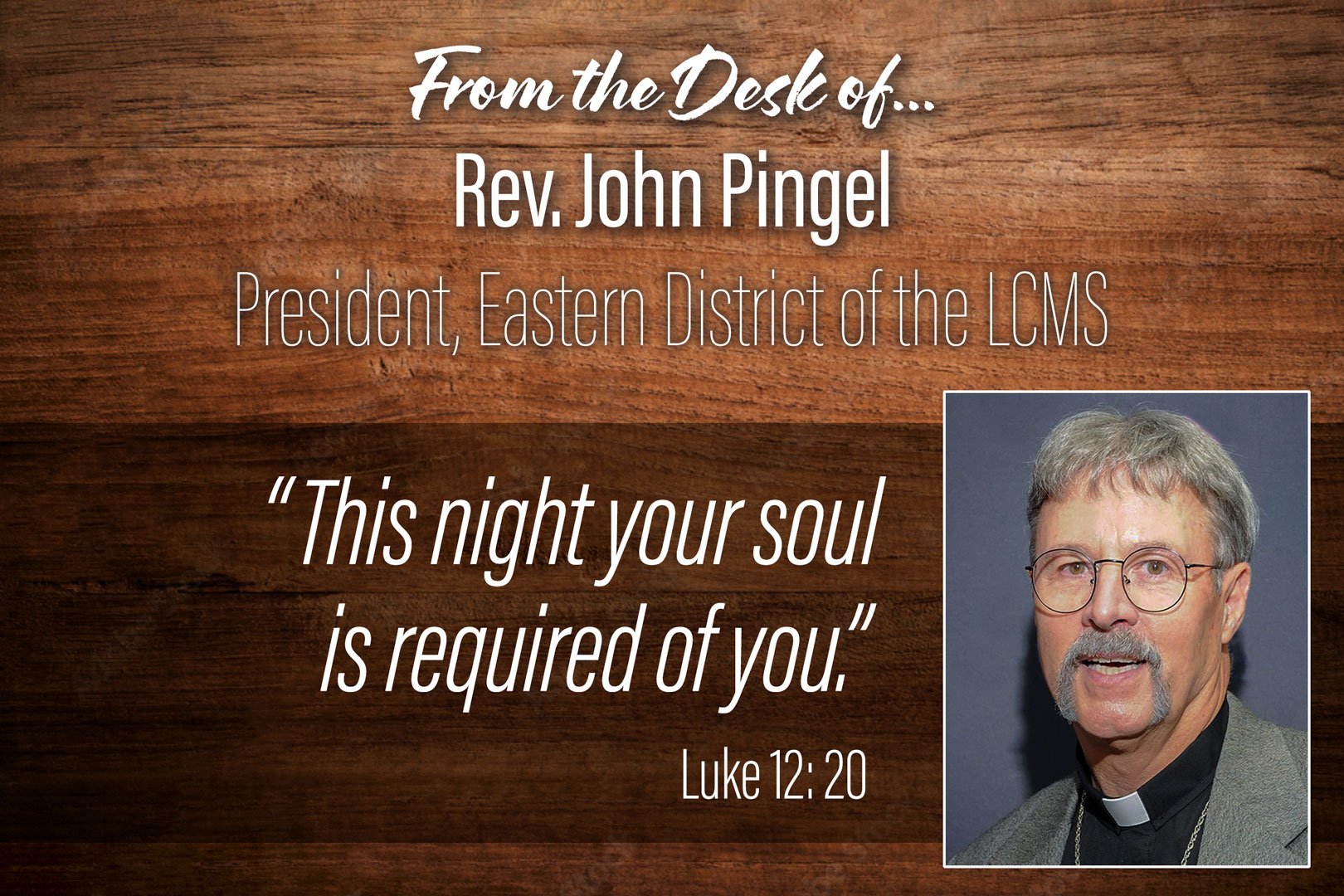
“This night your soul is required of you.” Luke 12: 20
What are the most sobering words in the world? By “sobering” I mean words that cause us to stop in our tracks and do some honest evaluating of our lives -- where we’ve been, where we’re at, our hopes and dreams for the future. So … what are the most sobering words in the world? I believe I have found them, not surprisingly, right here in my Bible! Words spoken to a man in the prime of life, living a busy life, enjoying what most would consider enviable success … a man who had BIG PLANS for the future.
It all came to a grinding halt one night. God said to the man: “Time’s up. Come with me.” What took him? A sudden heart attack? A burst aneurism? A stroke? It doesn’t say. But God called. And whether he was ready or not ready, make no mistake, he went.
Jesus was in the process of teaching his followers on how to live courageously in the face of adversity. “Don’t be afraid of those who can kill the body but cannot kill the soul” he told them.“ Acknowledge me before men and I will acknowledge you before the Father.” In the middle of his teaching, he was interrupted by a man with far more “important” things on his mind -- relatives squabbling over an inheritance. In those days, the oldest brother received something like 2/3 of what was left behind. The rest got divided up by the other brothers. Unequal shares were often allotted, which made the situation ripe for envy and jealousy. Disputes were common, and the local rabbi was often dragged in to settle the dispute. Jesus, the traveling rabbi, was conveniently approached on this matter. His response was basically “Don’t put me in the middle of your family squabble.” Jesus seized upon the situation to teach a lesson on life, and death, and the RELATIVE VALUE of material possessions.
The story Jesus told was about a man who was rich. He owned a bunch of land that produced a very good crop. In those days, grain was the equivalent of cash. This man was rich and he had just gotten richer. In fact, he was the envy of all! He had more grain than his barns could hold!
Notice, in his mind, there was no question as to whether his wealth would last … or whether HE would last! And so he says to himself (v. 18): “I know what I will do. I’ll build bigger barns.” A typical solution. A construction program to solve my storage problem. Plus, it will show everyone in town what a successful man I am! I’ll be the toast of the town! And so the rich man builds his barns, and leans back in his fancy recliner. I’m all set, he reasons. I’ve got plenty of good things laid up for many years. I can take life easy, eat, drink and be merry. Let famine come! Let the economy go south! Let the market tank! I’m prepared! I’m self-sufficient! No thought of the needy. No thought of neighbor. No thought of … God.
In the middle of the night, God speaks. “Hey, rich man.” A voice from God himself? Or an emissary? The Grim Reaper, perhaps. Like the one in “A Christmas Carol.” “The Ghost of Christmas Future”—bony finger sticking out from his cowl.
God: “Hey, Rich Man.”
Rich Man: “You talking to me?”
God: “Yeah, I’m talking to you. Come with me.”
Rich Man: “But you don’t understand! I’ve got BIG PLANS!”
God: "Fool. You don’t get to call the shots. I call the shots. Come along.”
You see, it really doesn’t matter what took him or how the message was delivered. The fact of the matter is, he wasn’t prepared. His first mistake was thinking that HE was in the driver’s seat, the arbiter of his own destiny! But God said: “This night. Your soul. Required of you.”
The word used here in the original Greek carries with it the idea of a LOAN which now must be repaid … in this case, to God. The subsequent question God asks the man in the story is sobering, too. “Then who will get what you have prepared for yourself?” The answer is, relatives will descend, like vultures. You’ve seen it before. Family members come forward, and the squabbling begins!
There are several points to the story:
First of all, the story points out the fragility of human life. We live as if we are guaranteed tomorrow. But that’s just an illusion. I’m not suggesting that we live in a morbid fashion, and that’s not what Jesus is suggesting here. But a sense of our mortality is a healthy thing. It helps us keep things in perspective and sort out what’s important. We are to view life as a gift indeed; value it; savor the moment; cherish our loved ones; show love and appreciation and caring while we can.
But the main point the story makes has to do with money and material goods. Things. Stuff. Ultimate value must not be placed on these things, says Our Lord, because they are temporary. In the end, it all gets left behind. Sometimes people will ask: “How much did so and so leave behind?” The answer is —everything. All of it.
Thus we find in this story the foundation of what we call Christian Stewardship. In the final analysis, we don’t own anything. All that we consider “ours” is really owned by God—on loan—and in the end it all gets turned back in. Therefore it behooves us to live in view of eternity, using the resources God has placed at our disposal so as to, in Jesus own words, “Be rich toward God.” We are to live life accordingly, placing highest value on the more important things: love, caring, sharing, generosity, and honoring God with one’s life … which is something we, as Christians, are uniquely positioned to do. Why? Because we live our lives, as Saint Paul puts it, “In view of God's mercy.” Behold the cross. The heart filled with gratitude for God’s salvation in Jesus looks around with newfound clarity, sees God’s hand in all the blessings of life, and says: “Not MY wealth, O God, but YOUR wealth! Not MY stuff, but YOUR stuff! Heavenly Father, help me to use these things to acknowledge you, glorify you, and show my thankfulness to you, in Jesus’ Name.”
– By Rev. John Pingel, President, Eastern District of the LCMS