

AUDIO: Announcements, Readings & Sermon for Sunday March 24, 2024 - Palm Sunday
This audio-only file includes all the readings from scripture, along with the sermon — and when available, the announcements, adult choir, men’s choir, and/or bell choir. Also posted along with the audio file is the text for all the scripture readings, and a link to the current bulletin, and our YouTube channel if you prefer to watch the LIVE Stream.
View the bulletin for Sunday, March 24, 2024
Archive of AUDIO “Readings & Sermons”
Archive of VIDEO “Complete Service”
Archive of Bulletins
Old Testament Reading -- Zechariah 9:9–12
Rejoice greatly, O daughter of Zion!
Shout aloud, O daughter of Jerusalem!
behold, your king is coming to you;
righteous and having salvation is he,
humble and mounted on a donkey,
on a colt, the foal of a donkey.
I will cut off the chariot from Ephraim
and the war horse from Jerusalem;
and the battle bow shall be cut off,
and he shall speak peace to the nations;
his rule shall be from sea to sea,
and from the River to the ends of the earth.
As for you also, because of the blood of my covenant with you,
I will set your prisoners free from the waterless pit.
Return to your stronghold, O prisoners of hope;
today I declare that I will restore to you double.
Epistle Reading -- Philippians 2:5–11
Have this mind among yourselves, which is yours in Christ Jesus, who, though he was in the form of God, did not count equality with God a thing to be grasped, but made himself nothing, taking the form of a servant, being born in the likeness of men. And being found in human form, he humbled himself by becoming obedient to the point of death, even death on a cross. Therefore God has highly exalted him and bestowed on him the name that is above every name, so that at the name of Jesus every knee should bow, in heaven and on earth and under the earth, and every tongue confess that Jesus Christ is Lord, to the glory of God the Father.
The Holy Gospel according to St. Mark, the eleventh chapter
When they drew near to Jerusalem, to Bethphage and Bethany, at the Mount of Olives, Jesus sent two of his disciples and said to them, “Go into the village in front of you, and immediately as you enter it you will find a colt tied, on which no one has ever sat. Untie it and bring it. If anyone says to you, ‘Why are you doing this?’ say, ‘The Lord has need of it and will send it back here immediately.’” And they went away and found a colt tied at a door outside in the street, and they untied it. And some of those standing there said to them, “What are you doing, untying the colt?” And they told them what Jesus had said, and they let them go. And they brought the colt to Jesus and threw their cloaks on it, and he sat on it. And many spread their cloaks on the road, and others spread leafy branches that they had cut from the fields. And those who went before and those who followed were shouting, “Hosanna! Blessed is he who comes in the name of the Lord! Blessed is the coming kingdom of our father David! Hosanna in the highest!”
Bulletin: Sunday March 24, 2024
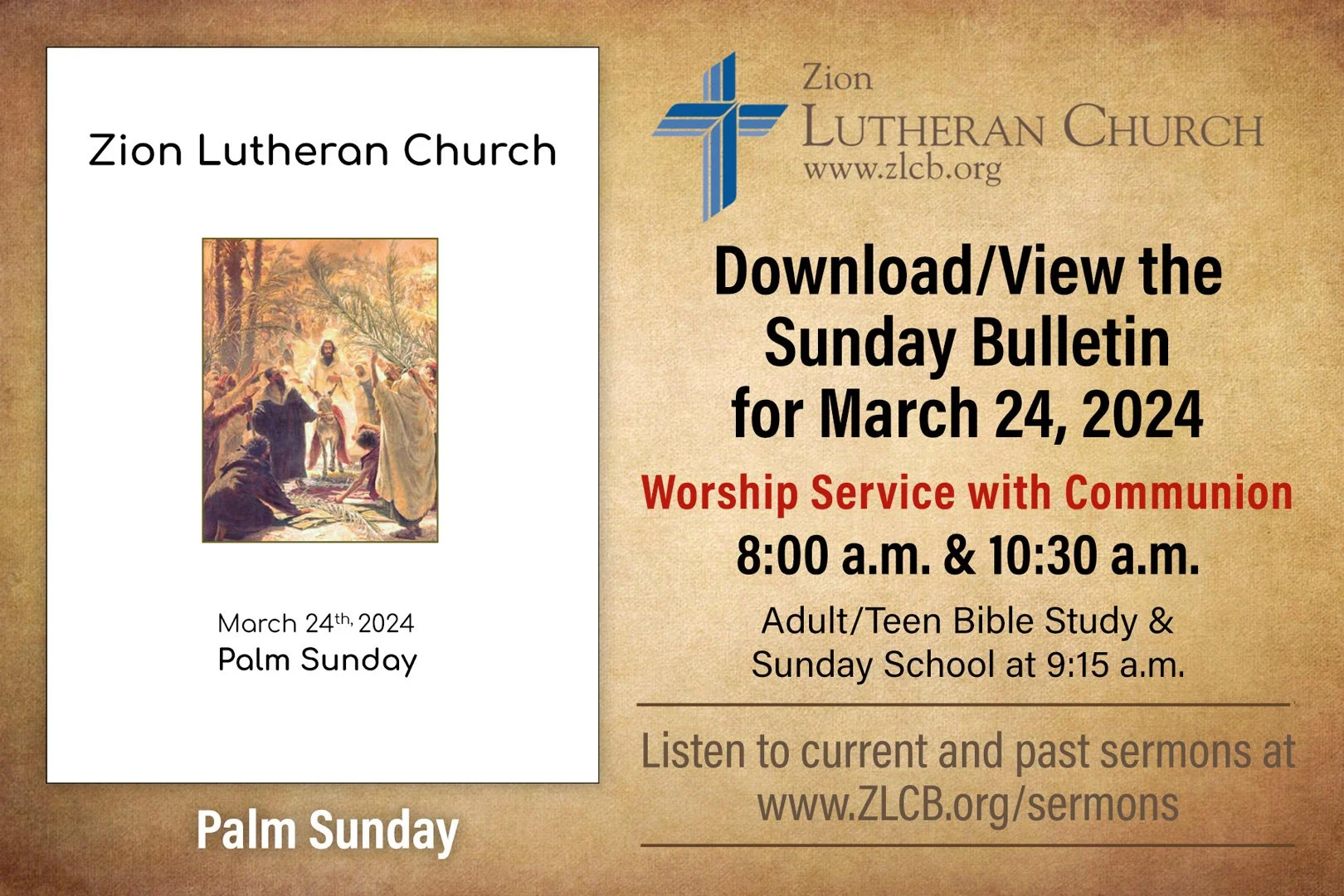
Download/view the latest bulletin. It’s filled with our hymns, the order of service, all the readings from scripture, prayer requests for family & friends, service participants, communion statement, about our worship, the schedule of events for this coming weeks, along with announcements, news updates, happenings, and more!
View the bulletin for Sunday, March 24, 2024
Archive of AUDIO “Readings & Sermons”
Archive of VIDEO “Complete Service”
Archive of Bulletins
THIS WEEK AT ZION:
Saturday March 23
No Events Scheduled
Sunday March 24
PALM SUNDAY
8:00 a.m. — Worship Service with Communion
9:15 a.m. — Adult/Teen Bible Study & Sunday School
10:30 a.m. — Worship Service with Communion
(The 8:00 a.m. service streamed on our YouTube channel)
Monday March 25
6:30 p.m. - Faith Bell Choir Practice
7:00 p.m. - 2nd Year Confirmation Class
Tuesday March 26
6:15 p.m. - Grace Bell Choir Practice
7:15 p.m. - Adult Choir Practice
Wednesday March 27
No Event’s Scheduled
Thursday March 28
MAUNDY THURSDAY (No Bible Study)
2:00 p.m. - Worship Service with Communion
7:00 p.m. - Worship Service with Communion
Friday March 29
GOOD FRIDAY
2:00 p.m. - Worship Service with Communion (prelude music begins at 1:30 p.m.)
7:00 p.m. - Worship Service with Communion (prelude music begins at 6:30 p.m.)
Saturday March 30
No Events Scheduled
Sunday March 31
EASTER SUNDAY
8:00 a.m. — Worship Service with Communion
9:00 a.m. — Easter Breakfast Buffet in the Fellowship Hall
10:30 a.m. — Worship Service with Communion
(The 8:00 a.m. service streamed on our YouTube channel)
What About … Being a Lutheran
The "What About..." Series, written by former Synod President A.L. Barry, is a series of 29 pamphlets that address doctrinal topics, moral issues, and concerns in the church. These questions are designed to help Christians grow in their understanding of these topics.
Use the link below to read the complete text …
What really is a Lutheran?
While there are a variety of ways one could answer this question, one very important answer is simply this, “A Lutheran is a person who believes, teaches and confesses the truths of God’s Word as they are summarized and confessed in the Book of Concord.” The Book of Concord contains the Lutheran confessions of faith. Perhaps you have attended an ordination of a pastor and heard him promise that he will perform the duties of his office in accord with the Lutheran Confessions. When people are confirmed they are asked if they confess the doctrine of the Evangelical Lutheran Church, as they have learned to know it from the Small Catechism, to be faithful and true. These solemn promises indicate to us just how important the Lutheran Confessions are for our church. Let’s take a look at the various items contained in the Book of Concord and then we'll look at why the Lutheran Confessions are so important for being a Lutheran.
What are the Ecumenical Creeds?
The three ecumenical creeds in the Book of Concord are the Apostles’ Creed, the Nicene Creed and the Athanasian Creed. They are called "ecumenical" [universal] because they are accepted by Christians worldwide as correct expressions of what God’s Word teaches.
What is the Augsburg Confession and Apology of the Augsburg Confession?
In the year 1530, the Lutherans were required to present their confession of faith before the emperor in Augsburg, Germany. Philip Melanchthon wrote the Augsburg Confession and it was read before the imperial court on June 30,1530. One year later, the Lutherans presented their defense of the Augsburg Confession, which is what “apology” here means. It too was written by Melanchthon. The largest document in the Book of Concord, its longest chapter, is devoted to the most important truth of the Christian faith: the doctrine of justification by grace alone, through faith alone, in Christ alone.
What are the Small and Large Catechisms?
Martin Luther realized early on how desperately ignorant the laity and clergy of his day were when it came to even the most basic truths of the Christian faith. Around 1530, he produced two small handbooks to help pastors and the heads of families teach the faith.
The Small Catechism and the Large Catechism are organized around six topics: the Ten Commandments, the Apostles’ Creed, the Lord's Prayer, Holy Baptism, Confession, and the Sacrament of the Altar. So universally accepted were these magnificent doctrinal summaries by Luther, that they were included as part of the Book of Concord.
What are the Smalcald Articles and the Treatise on the Power and Primacy of the Pope?
In 1537, Martin Luther was asked to prepare a statement of Lutheran belief for use at a church council, it if was called. Luther's bold and vigorous confession of faith was later incorporated into the Book of Concord. It was presented to a group of Lutheran rulers meeting in the town of Smalcald. Melanchthon was asked to expand on the subject of the Roman pope and did so in his treatise, which also was included in the Book of Concord.
What is the Formula of Concord?
After Luther's death in 1546, significant controversies broke out in the Lutheran Church. After much debate and struggle, the Formula of Concord in 1577 put an end to these doctrinal controversies and the Lutheran Church was able to move ahead unitedin what it believed, taught and confessed. In 1580, all the confessional writings mentioned here were gathered into a single volume, the Book of Concord. Concord is a word that means, "harmony".
What is the connection between the Bible and the Confessions?
We confess that, "The Word of God is and should remain the sole rule and norm of all doctrine" (FC SD, Rule and Norm, 9). What the bible asserts, God asserts. What the Bible commands, God commands. The authority of the Scriptures is complete, certain and final. The Scriptures are accepted by the Lutheran Confessions as the actual Word of God. The Lutheran Confessions urge us to believe the Scripture for "they will not lie to you" (LC, V, 76) and cannot be "false and deceitful" (FC SD,VII, 96). The Bible is God's "pure, infallible, and unalterable Word" (Preface to the BOC).
The Lutheran Confessions are the "basis, rule an norm indicating how all doctrines should be judged in conformity with the Word of God" (FC SD RN). Because the Confessions are in complete doctrinal agreement with the written Word of God, they serve as the standard in the Lutheran Church to determine what is faithful Biblical teaching, insofar as that teaching is addressed in the Confessions.
What is the main point of the Lutheran Confessions?
The Lutheran Reformation was not a "revolt", but rather began as a sincere expression of concern with the false and misleading teachings, which, unfortunately, even to this very day, obscure the glory and merit of Jesus Christ. What motivated Luther was a zealous concern about the Gospel of Jesus Christ. Here is how the Lutheran Confessions explain what the Gospel is all about:
"Human beings have not kept the law of God but have transgressed it. Their corrupted human nature, thoughts, words, and deed battle against the law. For this reason they are subject to God's wrath, to death and all temporal afflictions, and to the punishment of the fires of hell. As a result, the Gospel, in its strict sense, teaches what people should believe, namely, that they receive from God the forgiveness of sins; that is, the Son of God, our Lord Christ, has taken upon Himself the curse of the law and borne it, atoned and paid for all our sins; that through Him alone we are restored to God's grace, obtain the forgiveness of sins through faith and are delivered from death and all the punishments of our sins and are saved eternally. … It is good news, joyous news, that God does not want to punish sin but to forgive it for Christ's sake" (FC SD,V,20).
What is a "confessional" Lutheran?
The word "confession" is used in a variety of ways, but when we speak of a "confessional" Lutheran we mean a Lutheran who declares to the world his faith and most deeply held belief and conviction, in harmony with the documents contained in the Book of Concord. You will catch the spirit of confessional Lutheranism in these, the last words written in the Book of Concord:
"Therefore, it is our intent to give witness before God and all Christendom, among those who are alive today and those who will come after us, that the explanation here set forth regarding all the controversial articles of faith which we have addressed and explained -- and no other explanation -- is our teaching, faith, and confession. In it we shall appear before the judgment throne of Jesus Christ, by God's grace, with fearless hearts and thus give account of our faith, and we will neither secretly nor publicly speak or write anything contrary to it. Instead, on the strength of God's grace, we intend to abide by this confession" (FC SD, XII, 40).
What is "unconditional subscription" to the Confessions?
Confessional Lutheran pastors are required to "subscribe" unconditionally to the Lutheran Confessions because they are a pure exposition of the Word of God. This is the way our pastor, and every layman who confesses his belief in the Small Catechism, is able with great joy and without reservation or qualification to say what it is that he believes to be the truth of God's Word.
So what is it to be a Lutheran?
Being a Lutheran is being a person who believes the truths of God's Word as they are correctly explained in the Book of Concord. To do so is to confess the Gospel of Jesus Christ. Genuine Lutherans, confessional Lutherans, dare to insist that "All doctrines should conform to the standards [the Lutheran Confessions] set forth above. Whatever is contrary to them should be rejected and condemned as opposed to the unanimous declaration of our faith" (FC Ep. RN, 6).
Such a statement may strike some as boastful, but it is not. Rather, it is an expression of the Spirit-led confidence that moves us to speak of our faith before the world.
Hand-in-hand with our commitment to pure teaching and confession is our equally strong commitment to reaching out boldly with the Gospel and speaking God's truth to the world. That is what "confession" of the faith is all about, in the final analysis. Indeed, "It is written: 'I believed; therefore I have spoken.' With that same spirit of faith we also believe and therefore speak (2 Cor. 4:13). This is what it means to be a Lutheran.
by Dr. A. L. Barry
Past President (1992-2001)
The Lutheran Church—Missouri Synod
Worship Nurtures a Community
In the first installment of this series, I highlighted the unique character of the Christian community as one created by God. While other communities are based on common human activities, desires, persuasions and identities, the Christian community is based upon — and created by — divine activity. This is seen most clearly when Christians gather for worship, as the Divine Service is a manifestation of the fellowship created for us in Christ Jesus, and a chief venue for the Holy Spirit to perform His work of enlightening and sanctifying us in the Christian faith.
Use the link below to read the complete text …
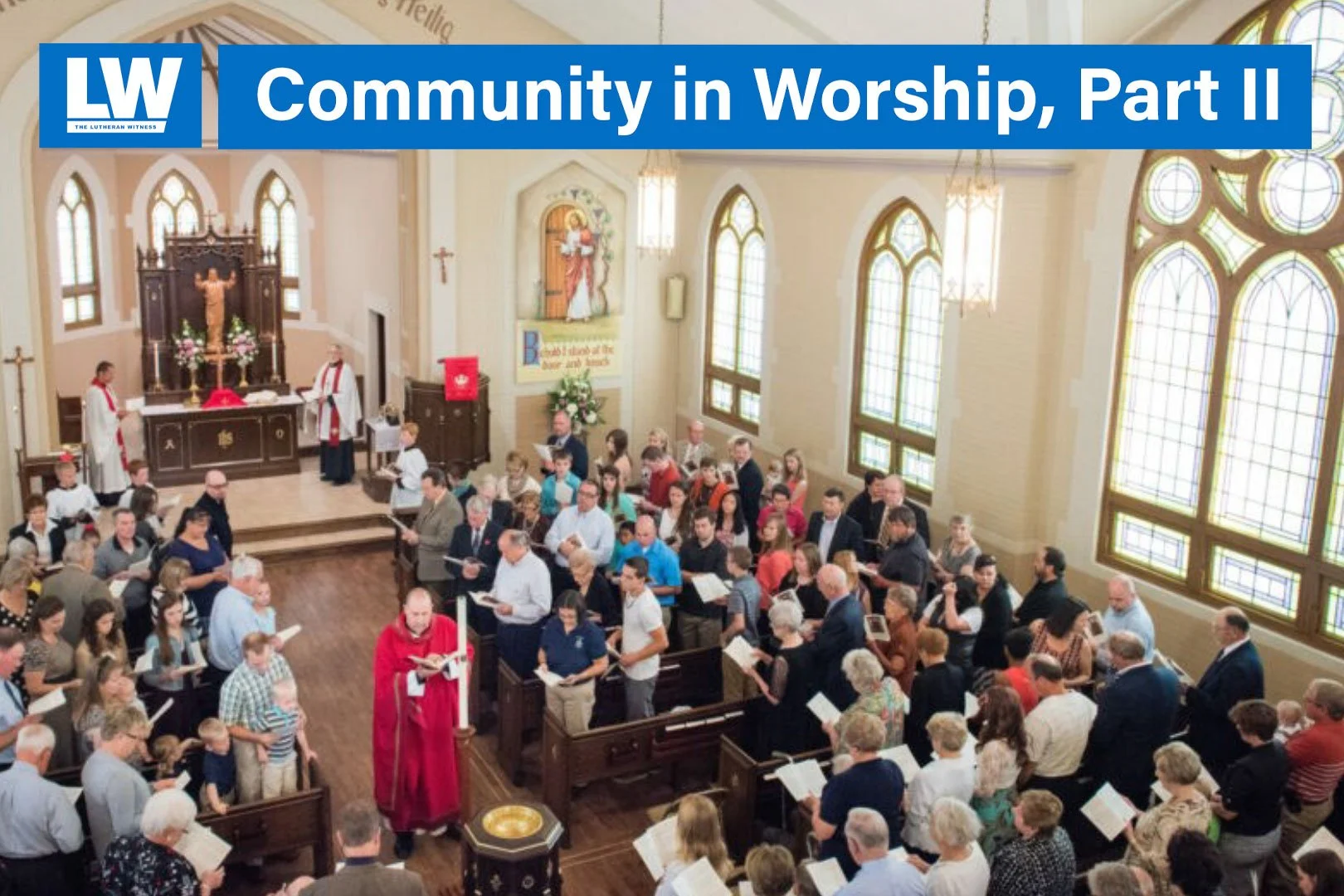
Community in Worship, Part II:
That Is Alien to This World
By Phillip Magness
In the first installment of this series, I highlighted the unique character of the Christian community as one created by God. While other communities are based on common human activities, desires, persuasions and identities, the Christian community is based upon — and created by — divine activity. This is seen most clearly when Christians gather for worship, as the Divine Service is a manifestation of the fellowship created for us in Christ Jesus, and a chief venue for the Holy Spirit to perform His work of enlightening and sanctifying us in the Christian faith.
As the Lord has His way with us in worship, a culture alien to this world is formed. In this culture of Christian community, we are nurtured in faith. We grow not only in our own sanctification but are built up with the whole church into the people God intends us to be. Indeed, worship and culture are intrinsically linked. One sees this readily in Romantic languages, where the word for “worship” is a form of the Latin cultus, rather than the Old English worth-ship. In worship, the true and the good are grown — literally cultivated. We are His workmanship (Eph. 2:10), souls in which He works His good and perfect will and accomplishes His purposes (Phil. 1:6).
The Divine Service and all the daily prayer offices (Matins, Vespers, Compline) form us into a unique community. No other community is so tethered to the Lord of heaven and earth. The peace we receive from God through the proclamation of the Gospel for the forgiveness of sins passes all human understanding, as it is an alien peace (Phil. 4:7). It is an extraordinary peace from Jesus Himself, bestowed upon us by the Holy Spirit (John 14:23).
We receive this peace with the whole Christian church on earth as the Spirit sanctifies us and keeps us with Jesus Christ in the one true faith (Luther’s Small Catechism, Third Article). In this
way, worship manifests a community that is in the world, but not of it (John 17:16–27). We are not of the world because we have received an alien righteousness — that is, a righteousness
not of our doing, but of God’s. Possessing an alien righteousness, we form a community that is alien to this world.
In this alien community, we are not static. We are nurtured in faith as we grow in righteousness. The activities of Christian worship grow our faith and strengthen the bonds we share as the Body of Christ. As this happens, our ways and patterns of worship take on a richness all their own. Just as a man-made community develops art, music, sculpture and ceremonies that enrich and magnify the community’s activities, so does the culture of the church.
As the church, we enjoy the fruits of holy culture as our participation in the Means of Grace entails actually doing things. While we passively receive an alien righteousness, we are active participants in the Lord’s work. Our mouths sing, proclaim and confess. We eat and drink the Lord’s Supper, which requires movement and vessels. Our sanctuaries are adorned with liturgical art that evokes Scripture and reinforces the Gospel message. Candles are lit, and pastors move as the action of the liturgy takes us from font to lectern to pulpit to altar.
Many congregations reinforce our reception of this alien righteousness by processing a cross, reminding worshipers than salvation comes to us extra nos, from “outside ourselves.” The ways in which all this is done vary according to the local context but are all rooted in the common ways in which Christian culture has been formed since ancient times: the proclamation of the Word, the preaching of the Gospel, and the administration of the Sacraments. The rich and varied ways in which we participate in these tasks nurture a holy culture among us as we look forward to the ultimate cultus at the throne of the Lamb (Rev. 22:3).
The habits of being in Christian culture allow for the Word to dwell in us richly (Eph. 5:18; Col. 3:16; Heb. 10:25) and keep us growing in our faith. Yet, precisely because this is such a blessing, it also carries a risk. While the way in which a congregation goes about its holy tasks can rightly be cherished as they bring us Gospel gifts, traditions can also become idols for us. Indeed, the medieval church’s elevation of traditions was a chief reason the church needed the Reformation! So it is important — vitally important — that we always keep such things in perspective.
It is good, right and natural to love special hymns, a certain architecture, the way your pastor conducts the service, or the way in which the Lord’s song is led in your congregation. You are being nurtured in the culture of the church through these wonderful things. But we must always fix our hearts on the gifts they deliver; for as important as it is to have a packaging that reflects what is inside, the real seed that is sown in us through the culture of the church is the Gospel. May we always cherish the culture of the church — and of our own congregations within that church — but may we do so only for the sake of what God does for us in that alien culture through His Word and Spirit.
VIDEO: Wednesday March 20, 2024 - Complete Service
Each service at Zion Lutheran Church (normally the first of our two services) is streamed LIVE on our YouTube channel. This includes Sunday’s, Wednesday’s, Lenten, Advent and special services. The entire service is streamed from beginning-to-end. Weddings and Funerals can also be streamed, if requested in advance.
View the Bulletin for Wednesday, March 20, 2024
2:00 p.m. - Worship Service with Communion
2:30 p.m. - 30 min. Bible Study “MIGHT” follow the 2:00 p.m. service
7:00 p.m. - Worship Service with Communion
All are welcome, bring a friend, neighbor or relative
Archive of AUDIO “Readings & Sermons”
Archive of BULLETINS
Visit our YouTube channel — Click the red “subscribe” box, and then click on the “bell” next to that box to receive Live Streaming notifications. You must be logged into YouTube to activate these features.
First Reading -- Jeremiah 9:12-16
Second Reading -- 2 Timothy 3:1–9
Third Reading -- Matthew 26:1–5
AUDIO: Readings & Sermon for Wednesday, March 20, 2024
VINDICATION (from today’s bulletin)
In Psalm 41:7–8, David lamented, “All who hate me whisper together about me; they imagine the worst for me. They say, ‘A deadly thing is poured out on him; he will not rise again from where he lies.’” These words pointed forward to our Lord Jesus Christ, who rose again in defiance of His enemies. Do you have enemies who whisper and scheme against you? Have you been brought low—perhaps so low that you despair of ever rising again? Jesus was vindicated in His resurrection, and you shall be too. You can have certainty in your resurrection and vindication because Jesus Christ is risen.
View the Bulletin for Wednesday, March 20, 2024
2:00 p.m. - Worship Service with Communion
7:00 p.m. - Worship Service with Communion
All are welcome, bring a friend, neighbor or relative
Archive of AUDIO “Readings & Sermons”
Archive of BULLETINS
Visit our YouTube channel — Click the red “subscribe” box, and then click on the “bell” next to that box to receive Live Streaming notifications. You must be logged into YouTube to activate these features.
First Reading -- Jeremiah 9:12-16
Who is the man so wise that he can understand this? To whom has the mouth of the Lord spoken, that he may declare it? Why is the land ruined and laid waste like a wilderness, so that no one passes through? And the Lord says: “Because they have forsaken My law that I set before them, and have not obeyed My voice or walked in accord with it, but have stubbornly followed their own hearts and have gone after the Baals, as their fathers taught them. Therefore thus says the Lord of hosts, the God of Israel: Behold, I will feed this people with bitter food, and give them poisonous water to drink. I will scatter them among the nations whom neither they nor their fathers have known, and I will send the sword after them, until I have consumed them.”
Second Reading -- 2 Timothy 3:1–9
But understand this, that in the last days there will come times of difficulty. For people will be lovers of self, lovers of money, proud, arrogant, abusive, disobedient to their parents, ungrateful, unholy, heartless, unappeasable, slanderous, without self-control, brutal, not loving good, treacherous, reckless, swollen with conceit, lovers of pleasure rather than lovers of God, having the appearance of godliness, but denying its power. Avoid such people. For among them are those who creep into households and capture weak women, burdened with sins and led astray by various passions, always learning and never able to arrive at a knowledge of the truth. Just as Jannes and Jambres opposed Moses, so these men also oppose the truth, men corrupted in mind and disqualified regarding the faith. But they will not get very far, for their folly will be plain to all, as was that of those two men.
Third Reading -- Matthew 26:1–5
When Jesus had finished all these sayings, He said to His disciples, “You know that after two days the Passover is coming, and the Son of Man will be delivered up to be crucified.”
Then the chief priests and the elders of the people gathered in the palace of the high priest, whose name was Caiaphas, and plotted together in order to arrest Jesus by stealth and kill Him. But they said, “Not during the feast, lest there be an uproar among the people.”
Bulletin: Thursday March 28, 2024 – Maundy Thursday
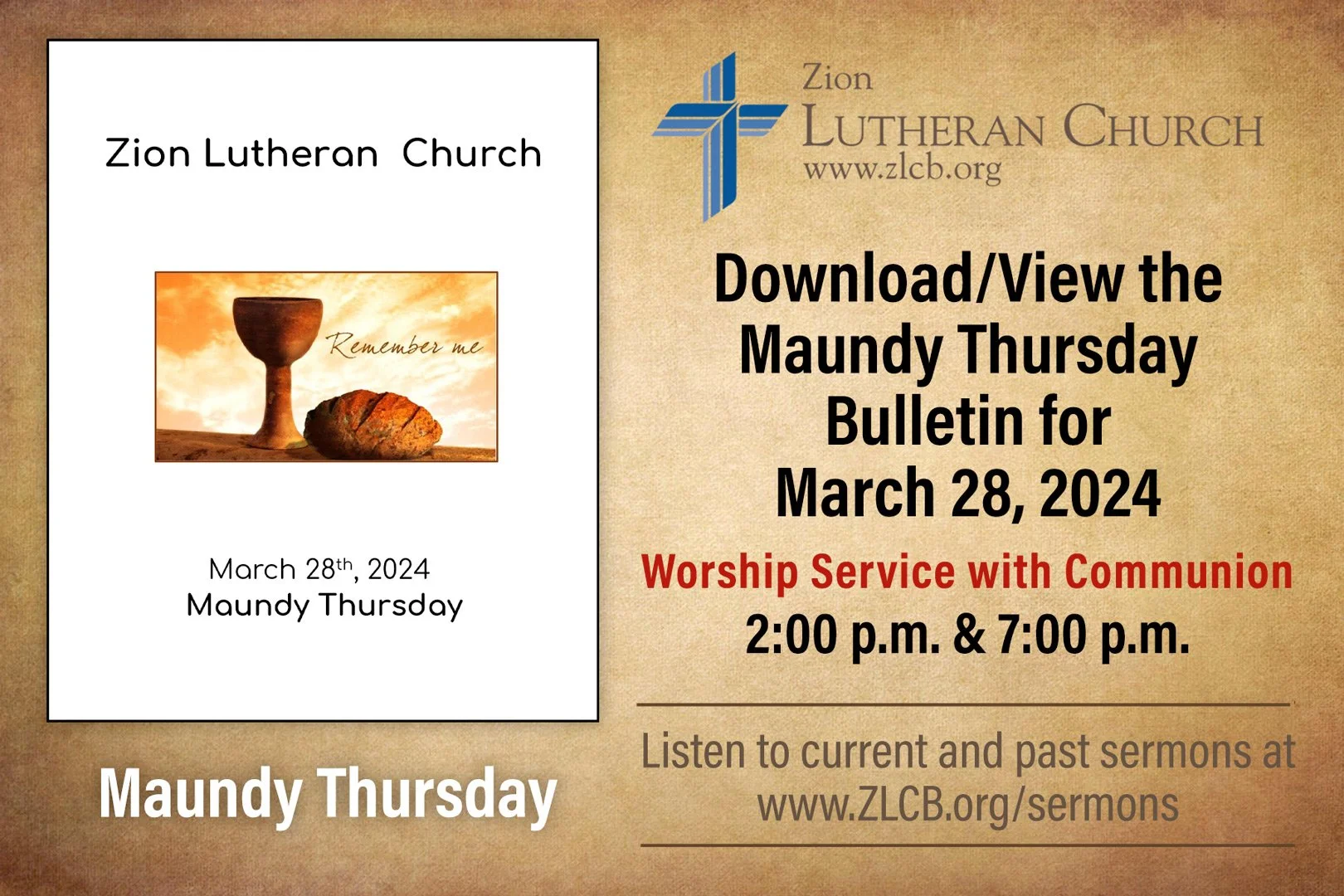
Download/view the latest bulletin.
It’s filled with our hymns, the order of service, all the readings from scripture, prayer requests for family & friends, service participants, communion statement, about our worship, the schedule of events for this coming weeks, along with announcements, news updates, happenings, and more!
View the Bulletin for Thursday, March 28, 2024
2:00 p.m. - Worship Service with Communion
7:00 p.m. - Worship Service with Communion
All are welcome, bring a friend, neighbor or relative
Let Us Love One Another, as Christ Jesus Has Loved Us and Loves Us to the End
“The LORD’s Passover” (Ex. 12:11) and “the blood of the covenant” at Mount Sinai (Ex. 24:8) foreshow the Lord’s Supper. The blood of Jesus Christ, the Lamb of God, now covers us, and we keep His Supper “as a feast to the LORD” (Ex. 12:14). In Him, we see “the God of Israel” (Ex. 24:10), and yet He does not lay His hand on us to punish us, but from His hand we eat and drink in peace. As our High Priest, He “entered once for all into the holy places … by means of his own blood, thus securing an eternal redemption” (Heb. 9:12). He shed His own blood in order to “purify our conscience” and bring us before His God and Father “without blemish” (Heb. 9:14). The holy apostles received this New Testament in His blood from the Lord Jesus “on the night when he was betrayed,” and they delivered the same to His Church, which we also now receive in the name and remembrance of Christ (1 Cor. 11:23–26; Matt. 26:26–28). He has “loved his own who were in the world,” and He loves us “to the end” (John 13:1); therefore, let us also “love one another” (John 13:34).
Visit our YouTube channel — Click the red “subscribe” box, and then click on the “bell” next to that box to receive Live Streaming notifications. You must be logged into YouTube to activate these features.
Archive of AUDIO “Readings & Sermons”
Archive of VIDEO “Complete Service”
Archive of BULLETINS