
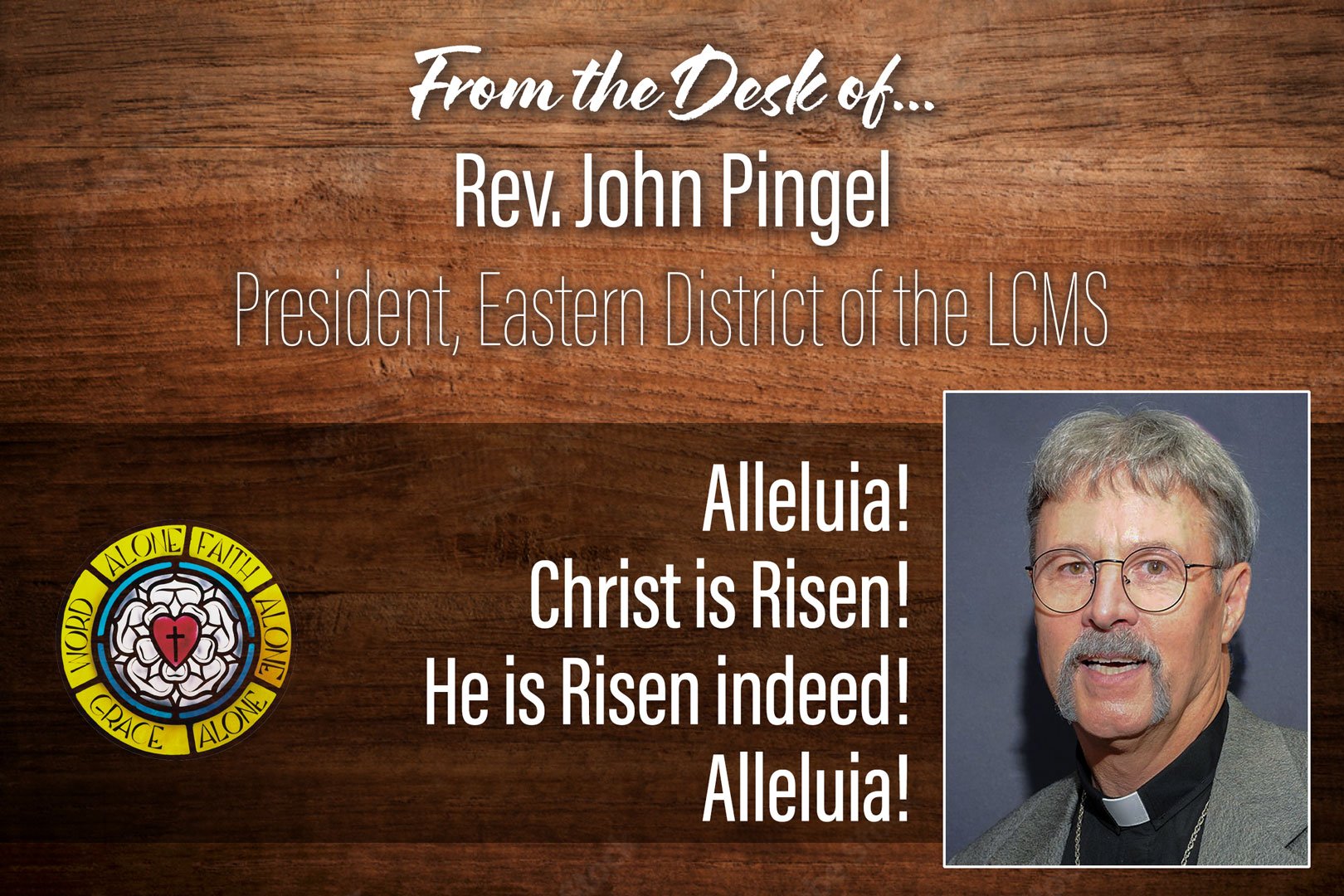
- By Rev. John Pingel, President, Eastern District of the LCMS
Happy Easter! I can say that all through the Easter Season, which, as you probably know, lasts seven full weeks. How important it is that we greet one another often with words of reverent joy: “Alleluia! Christ is Risen! He is Risen indeed! Alleluia!”
On Easter Sunday I noticed a larger than usual attendance at worship. In fact, there was a couple I didn’t know sitting directly in front of me. I did my best to greet them. I politely asked their names and bid them “welcome.” As I looked around, I noticed other visitors and began to ponder: How well will these fellow travelers on life’s highway be received? I know the pastor will do his best, but who among our members will take the time to welcome them? Will they emerge from church with a favorable impression? Will they be inclined to return?
My ponderings lead me to one of my favorite subjects, which is HOSPITALITY in churches. We all like to think of ourselves as “hospitable.” But how hospitable are we, really? True hospitality requires some effort and intentionality. The koine Greek word used by St. Paul for “hospitality” is “philoxenia.” Literally, “philoxenia” means “love of strangers.” It describes a specific virtue of welcoming people who are not part of one’s immediate circle of friends and acquaintances with tangible care and generosity. Paul uses this word and its related forms to describe a core duty for Christians. In Romans 12:19, he instructs believers to “practice hospitality”. When Paul tells the early Christians to “be hospitable” he isn’t telling them to be kind-hearted to friends. He’s telling Christians that we are called to show kindness and compassion to those we do not know at all.
It is helpful to place the word which Paul used in its cultural context. In Paul’s day, especially in large cities such as Rome and Ephesus, people were arriving with a common need: a place to reside during their brief stay. Remember, there were no Comfort Inns! For a Christian to be perceived as being hospitable, he often had to open his home to receive those displaced, or traveling through the area, since they relied on others for shelter, food, and protection. For this reason “philoxenia’ was a very important thing; it had a lot to do with one’s reputation. There was almost nothing worse than being deemed “inhospitable.” Word would surely get around!
Let us apply this concept to what we often refer to as our “church home.” How open and hospitable is our church home to those traveling on the road of life, be it on Easter Sunday or any other day of the year? In reality, true ministry often happens between holidays. Most of those who visit and wind up joining our church, arrive—not on Christmas or Easter—but on other days; like the 15th Sunday after Pentecost, the 4th Sunday after the Epiphany, or Labor Day weekend, for example. Therefore we must not “place all our eggs in one basket” with an over-emphasis on holidays, but rather cultivate a “culture of hospitality” all year long. It must include certain behaviors and be offered very intentionally, flowing genuinely out of love.
Allow me to extol the virtue of the coffee pot, the freshly baked cookie, the hand extended in fellowship. How might I sing the merits of the friendly smile? How commendable the eye of one who notices the newcomer at the door and takes the time and makes the effort to offer the stranger in our midst, the kind word and honest inquiry: “What brings you our way, friend?” As a parish pastor, there was no sight which delighted my heart more than seeing one of my parishioners sitting with a visitor, refusing to allow him to sit alone at a church event.
The hospitality we extend is at least as important as our attempts at what we often refer to as “outreach.” We may speak in glowing terms of “outreach” and yet fail miserably at the coffee pot. Of what value is bringing people, often at great expense and effort, through our door and then, for want of a better term, “blowing it” by either failing to recognize them or ignoring them because we are too busy talking to our friends? Philoxenia suggests otherwise, calling us to set aside our own needs for a moment, for purposes of tending to the needs of others and listening to the concerns of their hearts. Once again, the hospitality Paul suggests is a very intentional thing. When he says we need to be “given” to hospitality he uses the word “dioko” which means “to aggressively pursue something; to ardently follow after something until you finally catch it.” We are to put great effort, says Paul, into learning how to be welcoming and helpful. Romans 12:13 might very well be taken to mean, in the words of one commentator: “Hotly pursue and never stop pursuing the goal of becoming hospitable until you have caught on to the idea and genuinely become a hospitable person.”
The Fourth Sunday of Easter is often referred to as “Good Shepherd Sunday.” With this image in mind, allow me to commend to you the words of Pastor John Duke, Jr. to the people of Salem Lutheran in South Buffalo, which I think sum up nicely the mission of the church:
“That is why we are here … We are literally a pastureland for people, where the Good Shepherd calls. We are one part of an enormous pasture in Christ’s Church. This is our purpose. From our property, Jesus is making an appeal to every passer-by, everyone walking a dog, everyone pushing a stroller, everyone in doubt, making a passionate appeal that he loves them and wants them in his pasture of peace with us, where quiet waters flow.”